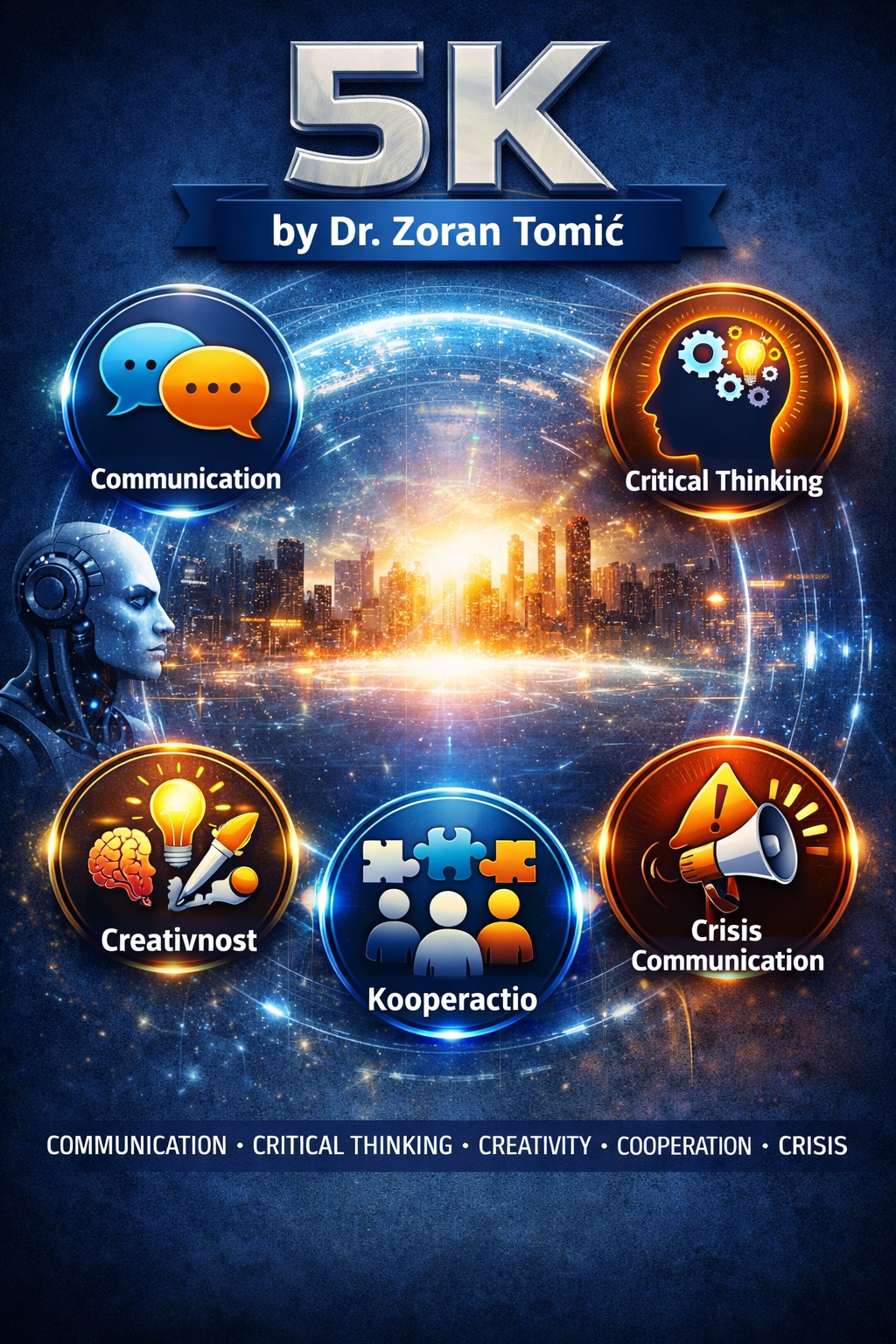
5K
In a world that is changing faster than we can fully comprehend, we continuously search for stable points of reference—something enduring, something that will not become obsolete tomorrow. As technology advances exponentially and artificial intelligence permeates every sphere of human activity, one fundamental question emerges: what, in essence, remains human?
The proposition that a large proportion of today’s professions will disappear is no longer speculative; it is an increasingly plausible reality. This is not because machines will surpass human intelligence in every dimension, but because they are already more efficient at routine, predictable, and repetitive tasks. The type of knowledge we acquire today—facts, formulas, procedures—has a limited lifespan. Perhaps not ten years, but certainly not thirty.
What does not become obsolete are the patterns of thinking and the structures of human interaction.
This is where the concept of the 5K emerges.
Communication
In an era where text, images, and entire presentations can be generated within seconds, the value of communication does not diminish; rather, it is transformed. It is no longer sufficient to simply “say something.” What becomes essential is the ability to understand context, emotion, and intent.
Artificial intelligence can produce linguistically flawless messages, yet it cannot fully grasp the moment when silence is more appropriate than speech, nor the subtle distinction between persuasion and manipulation.
Communication in the future is not merely the transmission of information; it is the construction of trust.
Critical Thinking
If artificial intelligence can generate thousands of responses within seconds, the central question becomes: which of these responses is meaningful and reliable?
Critical thinking extends beyond the ability to analyse data; it entails the capacity for scepticism—even toward what appears logically coherent. It functions as a filter that distinguishes truth from convincingly structured falsehoods.
In a context of informational overproduction, critical thinking becomes a new form of literacy.
Without it, individuals do not merely risk losing employment—they risk losing orientation.
Creativity
Paradoxically, as tools become more powerful, genuine creativity becomes increasingly scarce.
Artificial intelligence can generate infinite variations, yet it rarely produces ideas that fundamentally expand conceptual boundaries. Creativity is not merely the recombination of the existing; it is a leap into the unknown, often without any guarantee of success.
It emerges from lived experience, uncertainty, error, and even suffering—dimensions that algorithms may simulate but cannot authentically inhabit.
In the future, creativity will not constitute an added value; it will represent a primary currency.
Cooperation
Technological progress has connected individuals more than ever before, yet it has not necessarily rendered them more capable collaborators.
Cooperation presupposes elements that remain beyond the full comprehension of machines: compromise, empathy, and shared responsibility. It is not merely teamwork, but the capacity to transform differences into collective strength.
In a world where individuals have access to unprecedented resources, the true competitive advantage lies in the ability to work with others—not despite differences, but because of them.
Crisis Communication
Perhaps the most critical dimension of the 5K framework.
When systems operate smoothly, algorithms can manage processes effectively. However, in moments of crisis—uncertainty, conflict, systemic disruption—human judgment becomes indispensable.
Crisis communication is not limited to disseminating information; it involves guiding individuals and communities through uncertainty. It requires decision-making under conditions of incomplete data and the ability to maintain composure amidst chaos.
Artificial intelligence can model scenarios, but accountability for consequences remains inherently human.
Conclusion: What Endures Is Not Knowledge, but the Mode of Thinking
One of the most persistent misconceptions of our time is the belief that knowledge is permanent. It is not.
The specific competencies we acquire today—tools, techniques, even entire professions—are subject to rapid transformation and obsolescence. What endures are the cognitive and relational capacities through which knowledge is interpreted and applied.
The 5K framework is not a collection of so-called “soft skills.” It constitutes a new foundation for human relevance.
Artificial intelligence does not eliminate the human; it exposes the human condition.
It removes what is average, automatable, and devoid of depth, leaving us with an unavoidable question:
What, within us, truly holds value?
If anything is to endure over the next twenty-five or thirty years, it will not be the information we possess, but the capacities that shape how we engage with that information.
That is the essence of 5K.
And that is the future—one that is not reserved for machines.