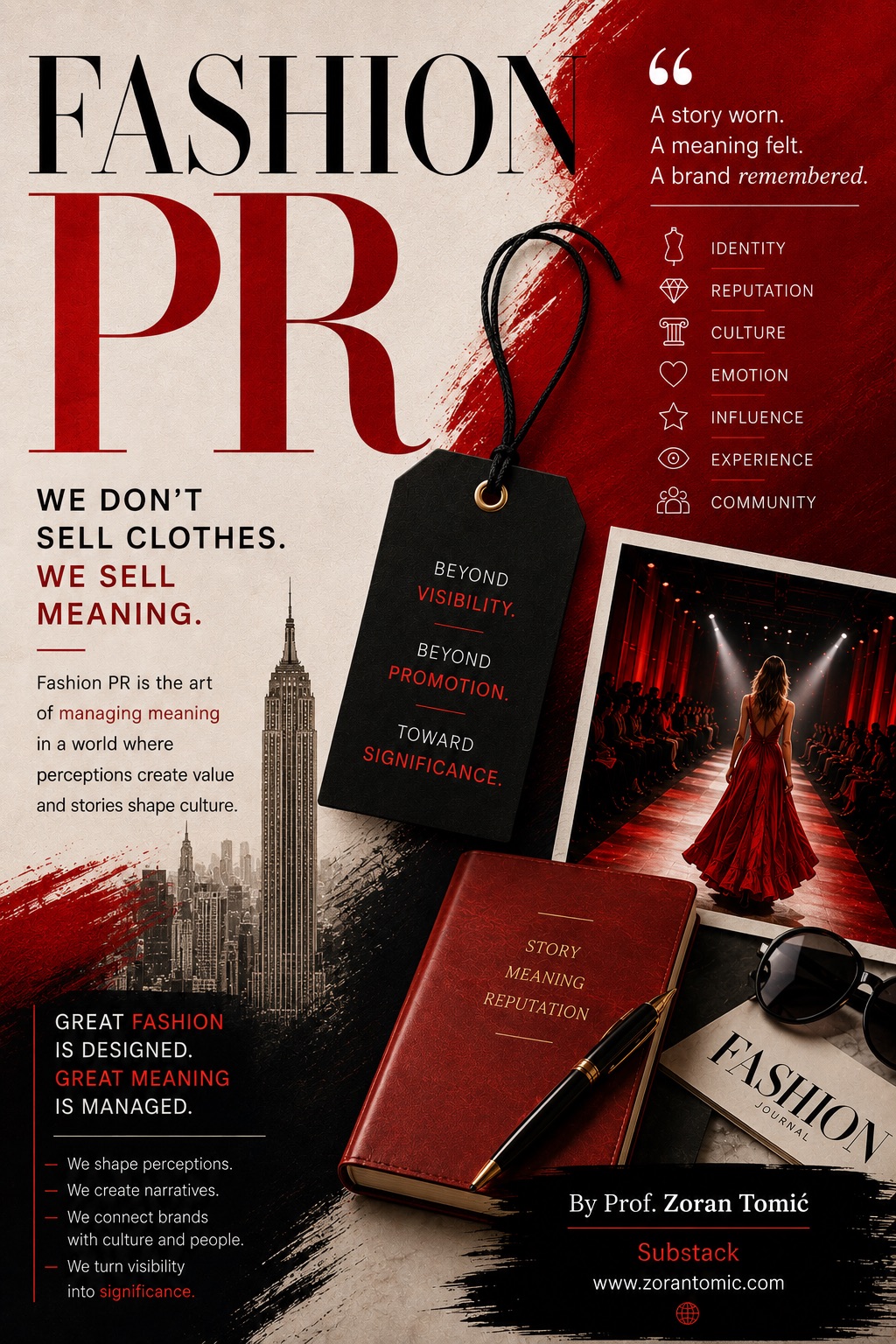
Fashion has never merely sold clothing. This may be the greatest misconception surrounding one of the world’s most influential industries.
When someone purchases a luxury handbag, a watch, or a pair of designer sneakers, they are rarely buying only a product. They are buying a sense of belonging. They are buying identity. They are buying status. Above all, they are buying a story about themselves—one that is communicated long before they utter a single word.
This is precisely why fashion has never been simply about commerce. It has always been about communication.
Moreover, wherever communication shapes perception, public relations assumes a central role.
However, Fashion PR is far more than promoting runway shows, distributing press releases, or organising glamorous events. These are merely its visible expressions. The most important work takes place far from the spotlight. It takes place in people’s minds.
The greatest value of a fashion house does not reside in its collections.
It resides in the meaning people attach to those collections.
Fashion Brands Do Not Manufacture Clothing. They Manufacture Identity.
The world’s most successful fashion houses understood long ago what many organisations have yet to recognise.
People do not buy products.
They buy versions of themselves.
Clothing serves as a medium through which individuals communicate who they are, where they belong, and the values they wish to express to the world.
This explains why two almost identical coats can command dramatically different prices.
The difference does not lie in the fabric.
The difference lies in meaning.
Meaning is never accidental. It is cultivated over years through visual identity, design, strategic communication, media narratives, fashion shows, collaborations with artists, carefully selected brand ambassadors, photography, cinema, music, and culture.
Fashion PR is the discipline that integrates all these elements into a coherent narrative.
Its purpose is not simply to ensure that audiences see a collection.
Its purpose is to ensure that audiences see themselves within that collection.
Runway Shows End. Stories Endure.
Many assume that the pinnacle of Fashion PR occurs when the lights dim after a runway show.
In reality, that is precisely when the real work begins.
A runway presentation lasts fifteen minutes.
Its communication may last for months.
Images travel across the world. Social media generates millions of new interpretations. Journalists select their highlights. Influencers assign their own meanings to the collection. Consumers connect it with their own lives and aspirations.
Suddenly, the very same dress becomes a symbol of elegance, rebellion, luxury, or freedom.
At that point, fashion is no longer about garments.
It becomes a matter of interpretation.
Moreover, interpretation is precisely where outstanding Fashion PR creates its greatest value.
Fashion PR Is Not Celebrity PR
One of the most common misconceptions is the assumption that Fashion PR and Celebrity PR are interchangeable.
They are not.
Certainly, both rely on public visibility.
Certainly, both collaborate with high-profile individuals.
However, their strategic objectives are fundamentally different.
Fashion PR builds the value of a fashion brand.
Celebrity PR enhances a person’s value.
When an actress wears a designer gown on the red carpet, Fashion PR seeks to inspire audiences to want it.
Celebrity PR seeks to inspire audiences to admire—and ultimately desire—the actress herself.
The distinction may appear subtle, but it fundamentally changes the entire communication strategy.
Within Fashion PR, the celebrity functions as a communication channel.
Within Celebrity PR, the celebrity is the brand itself.
In the former, the fashion house remains at the centre of the narrative.
In the latter, every communication activity ultimately serves to construct an individual’s personal brand.
For this reason, successful Fashion PR can never depend entirely on a single celebrity. Public figures may amplify the story, but they should never become the story.
The Digital Era Has Changed the Rules
There was a time when fashion editors determined what would become the next trend.
Today, that influence is shared by algorithms, influencers, artificial intelligence, and millions of users across digital platforms.
A single video can launch an unknown brand.
A single post can destroy a reputation built over decades.
A single photograph can become a global cultural symbol.
The speed at which meanings are now created is unprecedented in the history of the fashion industry.
Consequently, Fashion PR can no longer be understood merely as a media relations function.
It has evolved into the strategic management of perception in real time.
This transformation demands an entirely new set of competencies: an understanding of digital culture, algorithms, artificial intelligence, crisis communication, and the dynamics of online communities.
The Future of Fashion PR Is Meaning Management
It is here, I believe, that the profession is undergoing its most profound transformation.
For decades, public relations professionals have been described as managers of information, communication, or reputation.
However, in today’s digital society, information is no longer scarce.
Meaning is.
Few industries illustrate this reality more clearly than fashion.
A handbag, a dress, or a watch possesses no inherent meaning.
Meaning emerges only when people collectively construct it.
It is created through the media.
Through social platforms.
Through conversations.
Through everyday experiences.
Through popular culture.
Through shared interpretations.
This is precisely why the concept of Meaning Management offers a new theoretical lens through which Fashion PR can be understood. The role of the communication professional is no longer limited to organising communication activities or securing media visibility. Rather, it is to shape the environment in which stakeholders attribute desired meanings, values, and emotions to a fashion brand.
In other words, the contemporary Fashion PR professional becomes a Meaning Manager.
This is a far more demanding role than organising a runway show.
A runway presentation lasts only a few minutes.
Meaning can endure for decades.
Ultimately, the ability to create, manage, and protect meaning will distinguish fashion brands that merely follow trends from those that become part of culture itself.
Perhaps this is the most accurate definition of contemporary Fashion PR.
Its mission is not to sell clothing.
Its mission is to create meaning so compelling that people choose to wear the story the brand represents.