Prof. Zoran Tomić
Introduction: Are We Asking the Right Question?
The explosive growth of artificial intelligence has marked the past two years. Hardly a day goes by without discussions about ChatGPT, Gemini, Claude, Copilot, or another AI system promising to revolutionise the way we work, learn, and communicate. We talk about algorithms, automation, AI agents, content generation, and the future of countless professions.
However, amid this technological enthusiasm, a more important question emerges.
Have we begun to talk enough about intelligent communication?
At first glance, the two concepts may appear to be the same. They are not.
Artificial intelligence and intelligent communication are not synonymous. Artificial intelligence is a technology. Intelligent communication is a human capability.
In my view, this distinction will shape the development of communication studies over the coming decade.
Today, artificial intelligence can write articles, prepare press releases, analyse millions of social media posts, translate texts into almost any language, or even propose communication strategies. These are remarkable capabilities that will irreversibly transform the communication profession.
However, one question remains that no algorithm can fully answer:
What will the other person actually understand from all of this?
This question captures the essential difference between producing information and communicating intelligently.
To communicate intelligently means understanding that successful communication does not end when a message is sent. It ends only when the other person has understood that message in a way that enables mutual understanding, trust, and cooperation.
Intelligent communication cannot be reduced to rhetorical skill or the ability to persuade. It encompasses a much broader set of competencies.
It means knowing:
- what to say,
- when to say it,
- to whom to say it,
- how to say it,
- However, above all, understanding how the other person will interpret what we have said.
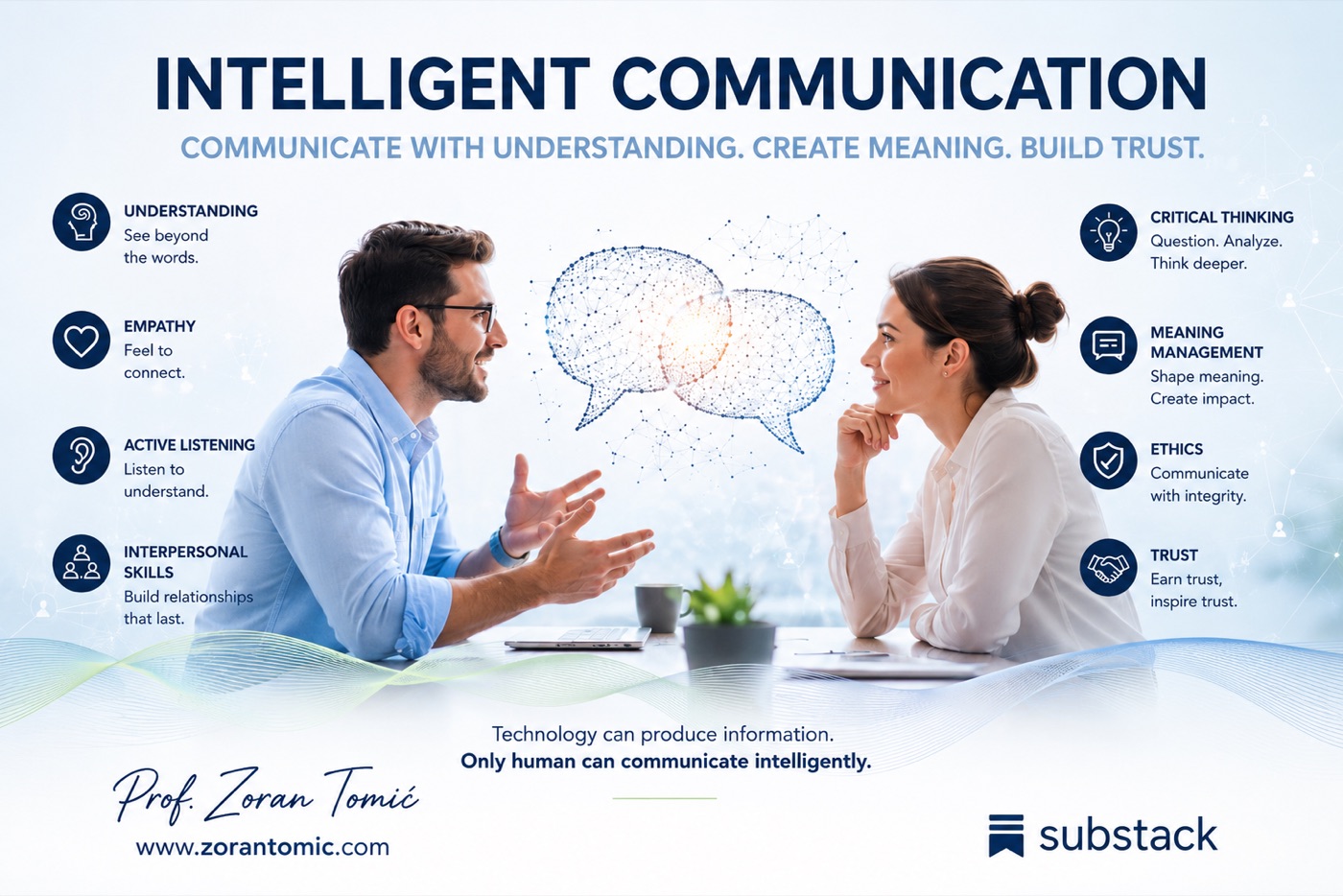
For this reason, intelligent communication integrates interpersonal skills, emotional intelligence, active listening, critical thinking, nonverbal communication, cultural sensitivity, ethical responsibility, and the ability to understand different perspectives.
In other words, it is fundamentally a human competency rather than a technological one.
Across many professions, artificial intelligence will take over a significant share of operational tasks. This will happen in public relations, marketing, journalism, education, and business communication alike.
Writing press releases, analysing media coverage, preparing reports, and personalising content will increasingly become automated processes.
However, precisely because of this, human competencies will become even more valuable.
Empathy cannot be automated.
Trust cannot be programmed.
Legitimacy cannot be generated with a single click.
Moreover, the ability to understand people will remain irreplaceable.
Perhaps, then, the future will not belong to those who use artificial intelligence most effectively.
Perhaps it will belong to those who understand people best.
I believe that Intelligent Communication will become one of the most important fields of communication studies over the next decade.
Not as another name for artificial intelligence.
However, as a new paradigm that connects technology and humanity.
A paradigm in which artificial intelligence is not a substitute for the communicator, but a powerful tool.
A paradigm in which communication excellence will no longer depend on the quantity of content produced, but on the ability to understand people, manage meaning, and build trust.
For this reason, I see intelligent communication as the next stage in the evolution of the communication profession.
Not after artificial intelligence.
But alongside it.
Technology will continue to advance. Artificial intelligence will become increasingly sophisticated, faster, and more efficient. It will generate information, analyse data, and automate communication processes better than ever before.
However, communication has never been merely the exchange of information.
Communication is understanding.
Communication is relationships.
Communication is trust.
That is why I believe the greatest value of future communication professionals will lie in their ability to communicate intelligently.
Technology can produce information.
Only human beings can communicate intelligently.