The leaders of the future will not succeed because they possess more information. They will succeed because they help people understand what that information means.
Over the past several decades, numerous leadership models have been developed. We speak of transformational, transactional, authentic, ethical, adaptive, and servant leadership. Each of these approaches has attempted to answer the same question: How can we effectively lead people in increasingly complex organisations?
Today, however, artificial intelligence is fundamentally changing that question.
If AI systems can analyse data, predict trends, and generate recommendations in seconds, what will remain the distinctive value of human leadership?
I believe the answer is not more knowledge.
The answer is Intelligent Leadership.
For a long time, we believed that great leaders were those who knew the most.
They were expected to have answers.
To make the right decisions.
To be the smartest person in the room.
For decades, this was the dominant image of leadership.
Today, that assumption no longer holds.
We live in a world where information evolves faster than any individual can absorb it. Artificial intelligence can analyse thousands of documents, compare scenarios, and generate sophisticated recommendations within seconds.
If knowledge is becoming universally accessible, it can no longer be the primary competitive advantage of a leader.
An intelligent leader therefore does not strive to know everything.
Their greatest strength is not having every answer.
Their greatest strength is asking the right questions.
Organisations rarely fail because they lack information.
More often, they fail because they stop listening to people.
Great leaders are not great because they speak the most.
They are great because they listen exceptionally well.
They listen to employees.
They listen to customers.
They listen to partners.
They listen to society.
An intelligent leader understands that the most valuable insights do not come only from reports and analytics.
They come from people.
That is why I believe intelligent listening is the foundation of intelligent leadership.
The greatest challenge facing modern organisations is no longer a lack of information.
It is an excess of it.
The real challenge lies in competing interpretations.
Employees interpret change differently.
The media frame decisions differently.
Customers perceive products differently.
Investors assess risks differently.
Stakeholders no longer respond only to facts.
They respond to what those facts mean.
This is why I believe the role of leadership is undergoing a profound transformation.
Leaders are no longer simply decision-makers.
They are becoming Managers of Meaning.
Their responsibility is no longer limited to deciding what the organisation does.
Their responsibility is to help people understand why the organisation acts as it does.
Artificial intelligence will continue to improve.
It will analyse markets.
Predict trends.
Simulate scenarios.
Recommend strategies.
Automate decisions.
However, there remains a uniquely human domain.
AI cannot assume responsibility.
It cannot become a moral authority.
It cannot build organisational culture.
It cannot create trust.
It cannot inspire people to pursue a shared vision.
These remain fundamentally human responsibilities.
Moreover, precisely because of this, the human dimension of leadership will become increasingly valuable in the years ahead.
I believe the coming decade will witness the emergence of a new leadership paradigm.
It will not be built on power.
It will not be built on control.
It will not be built on possessing more information than others.
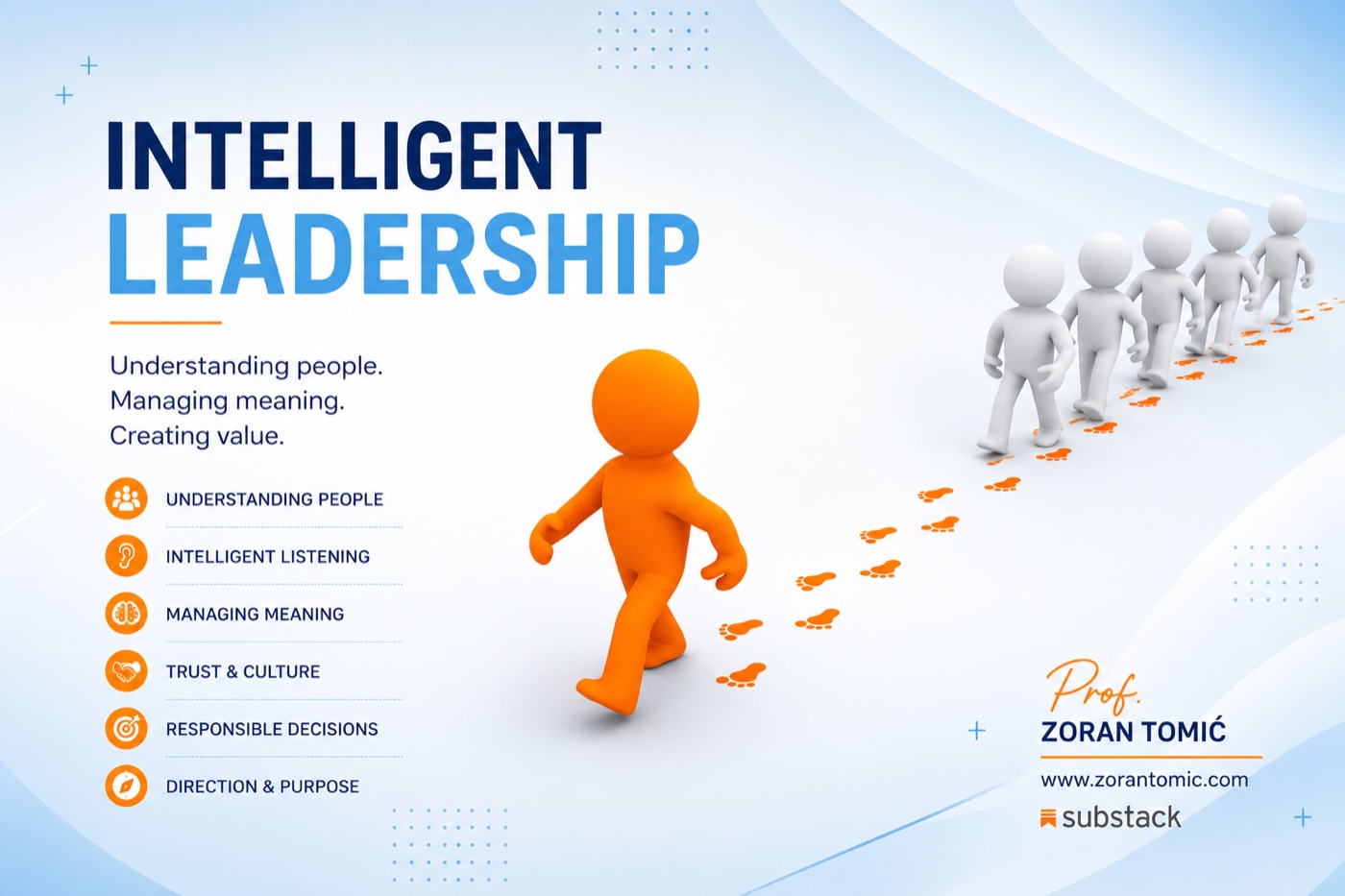
Instead, it will be grounded in the ability to understand people, practice intelligent listening, manage meaning, build trust, and make responsible decisions in an AI-driven world.
For this reason, I see Intelligent Leadership as the natural continuation of the concept of Intelligent Communication.
If the future of communication is about creating shared meaning, then the future leader will be the person who helps others find that shared meaning amid growing complexity.
Perhaps the greatest transformation brought by artificial intelligence is not technological.
Perhaps it is a reminder that in a world overflowing with information, the greatest human advantage will remain something that no algorithm can fully replicate:
the ability to understand people, build trust, and create shared meaning.
That, in my view, is the essence of Intelligent Leadership.