Luxury has never sold products. It has always sold meaning. What consumers truly buy is not a handbag, a watch, a car, or a hotel stay, but social status, cultural capital, membership in a particular world, and the symbolic affirmation of their own identity. This is precisely why Luxury PR is one of the most sophisticated fields of contemporary public relations. Its mission is not to increase a product’s visibility but to build, sustain, and protect the meaning embodied by a luxury brand.
This represents one of the fundamental distinctions between traditional marketing and contemporary public relations. Marketing may sell a product. Luxury PR sells its social meaning.
Luxury as a Communication Phenomenon
Luxury is, above all, a communicative construct. The value of a luxury product rarely derives solely from its materials, technology, or functionality. Its market value is created through the story that society accepts as true.
A gold watch tells time no more accurately than an ordinary watch. A luxury automobile takes its owner from point A to point B just as effectively as a far less expensive vehicle. A handcrafted handbag performs the same practical function as any other bag. The difference does not lie in functionality. The difference lies in meaning.
For this reason, Luxury PR does not manage products. It manages society’s interpretations of those products.
In the language of the new Meaning Management Theory in Public Relations, luxury brands do not primarily produce goods—they produce meanings that publics recognise as symbols of success, prestige, power, and excellence.
Luxury PR Is Not the Same as Fashion PR
One of the most common misconceptions is to equate Luxury PR with Fashion PR. Although fashion and luxury frequently intersect, they represent two fundamentally different communication philosophies.
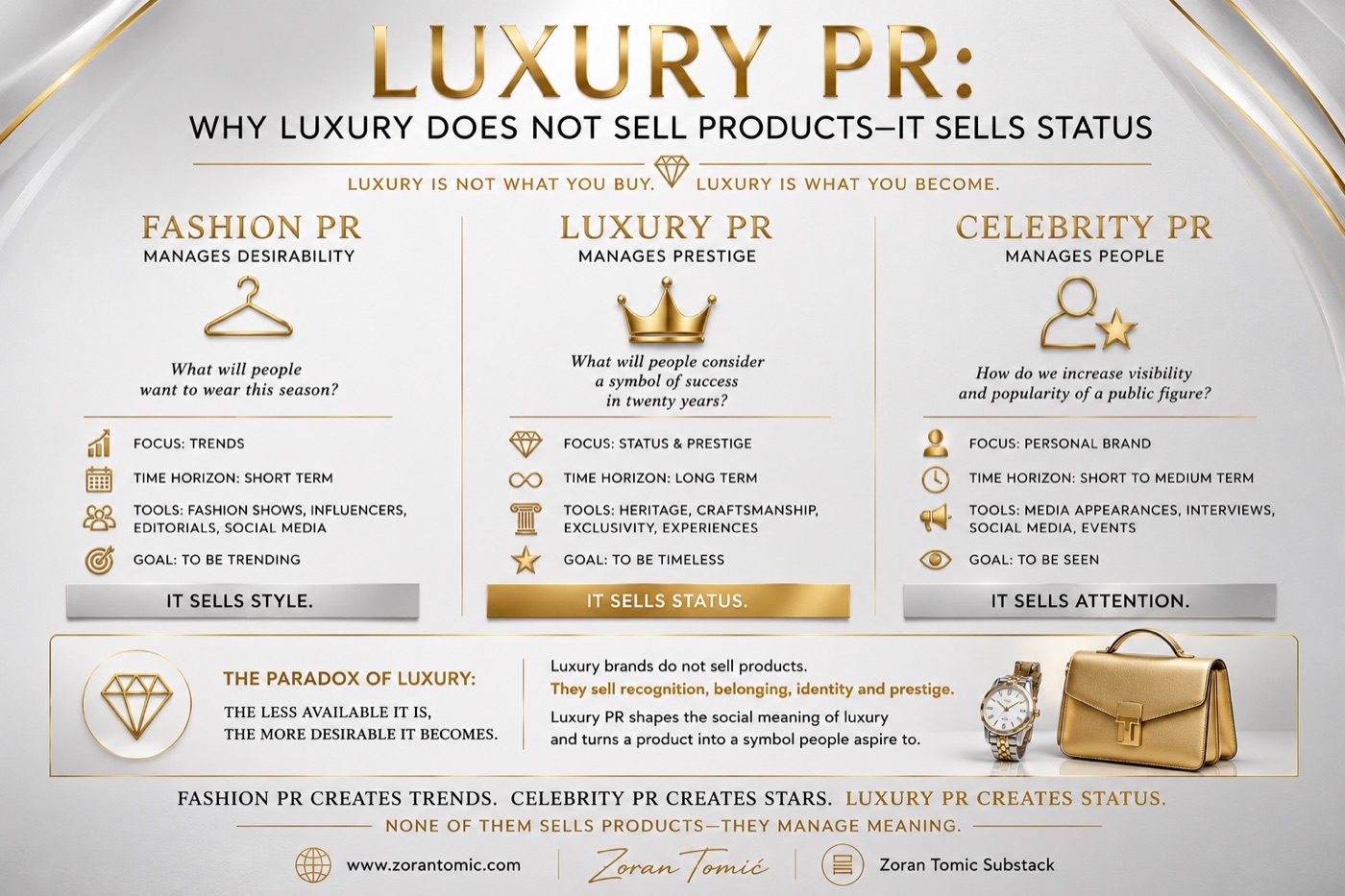
Fashion PR manages desirability.
Luxury PR manages prestige.
Fashion PR asks:
What will people want to wear this season?
Luxury PR asks an entirely different question:
What will people regard as a symbol of success twenty years from now?
Fashion is dynamic and cyclical. Trends emerge, evolve, and disappear. Collections come and go. What is desirable today may be forgotten tomorrow.
Luxury operates according to an entirely different logic.
Its greatest enemy is not obsolescence but the loss of prestige.
While Fashion PR creates desirability through fashion shows, influencers, editorials, social media, and seasonal campaigns, Luxury PR builds long-term reputation through heritage, scarcity, exceptional craftsmanship, cultural legacy, and experiences of exclusivity.
Fashion PR communicates trends.
Luxury PR communicates timelessness.
Luxury PR Is Not Celebrity PR Either
An even greater distinction exists between Luxury PR and Celebrity PR.
Celebrity PR manages a person.
Luxury PR manages a symbol.
Celebrity PR builds the public visibility of a well-known individual. Its objective is to increase a public figure’s exposure, popularity, emotional engagement, and market value.
Celebrity PR thrives on attention.
Luxury PR often thrives by limiting it.
While Celebrity PR seeks maximum media exposure, Luxury PR carefully controls when to communicate, where to appear, and whom to grant access to.
The paradox of luxury is that its value often increases precisely because it is not available to everyone.
Celebrity PR seeks to be seen.
Luxury PR seeks to be desired.
Celebrity PR increases the number of people who know the person.
Luxury PR increases the number of people who dream of the brand.
Here lies one of the most important differences in communication between popularity and prestige.
Popularity seeks the masses.
Prestige requires rarity.
Status Is the Most Expensive Product in the World
Luxury brands do not sell leather, gold, diamonds, or automobiles.
They sell social status.
Purchasing a luxury product is a communicative act. Consumers communicate not only what they own but also who they aspire to be in the eyes of others.
Every luxury product carries a symbolic message.
It speaks of success.
It speaks of taste.
It speaks of social standing.
It speaks of belonging to a particular cultural and economic elite.
For this reason, Luxury PR must understand sociology, psychology, anthropology, culture, symbolism, and communication just as deeply as it understands the media.
Luxury is not an economy of products.
Luxury is an economy of meaning.
Limited Availability as a Communication Strategy
One of the defining characteristics of Luxury PR is that success does not result from maximum accessibility.
Quite the opposite.
Many luxury brands deliberately limit production, distribution, and communication.
Waiting becomes part of the product.
Scarcity becomes part of the brand identity.
Exclusivity becomes the communication message.
Luxury PR, therefore, builds not only a reputation for quality but also for rarity.
The more difficult a symbol is to obtain, the greater its social value often becomes.
The Digital Era Is Transforming Luxury
Digital communication has also transformed the world of luxury.
Today, luxury brands no longer communicate solely through exclusive magazines or private events.
They communicate through social media, digital content, virtual experiences, and global communities.
However, the greatest challenge facing Luxury PR is not digital visibility.
Its greatest challenge is remaining exclusive in a world where everything is available with a single click.
This requires an entirely new level of meaning management.
The task is no longer merely to manage information.
It is to manage perceptions of rarity.
Luxury PR Through the Lens of PR 4.0
Within the PR 4.0 paradigm, Luxury PR acquires an entirely new theoretical dimension.
Its primary function is no longer the promotion of luxury products.
Its function becomes the management of the meaning of prestige.
If Fashion PR manages the meanings of trends, and Celebrity PR manages the meanings of personal brands, then Luxury PR manages the meanings of status.
Its greatest mission is not to increase the number of customers but to enhance the brand’s symbolic value within society’s collective consciousness.
This represents a transition from the economy of products to the economy of meaning.
Final Thought
The greatest misconception about luxury is the belief that people buy expensive products.
They do not.
They buy what those products mean.
They buy recognition.
They buy belongings.
They buy identity.
They buy prestige.
That is why Luxury PR is not a discipline that sells handbags, watches, automobiles, or hotels. Its true mission is to shape the social meaning of luxury and transform an ordinary product into a symbol people aspire to.
This is where its greatest communicative power resides.
Fashion PR creates trends. Celebrity PR creates stars. Luxury PR creates status. None of them fundamentally sells products—they all manage meaning. The only difference lies in the kind of meaning each seeks to make desirable.
Written by Professor Zoran Tomi
ć