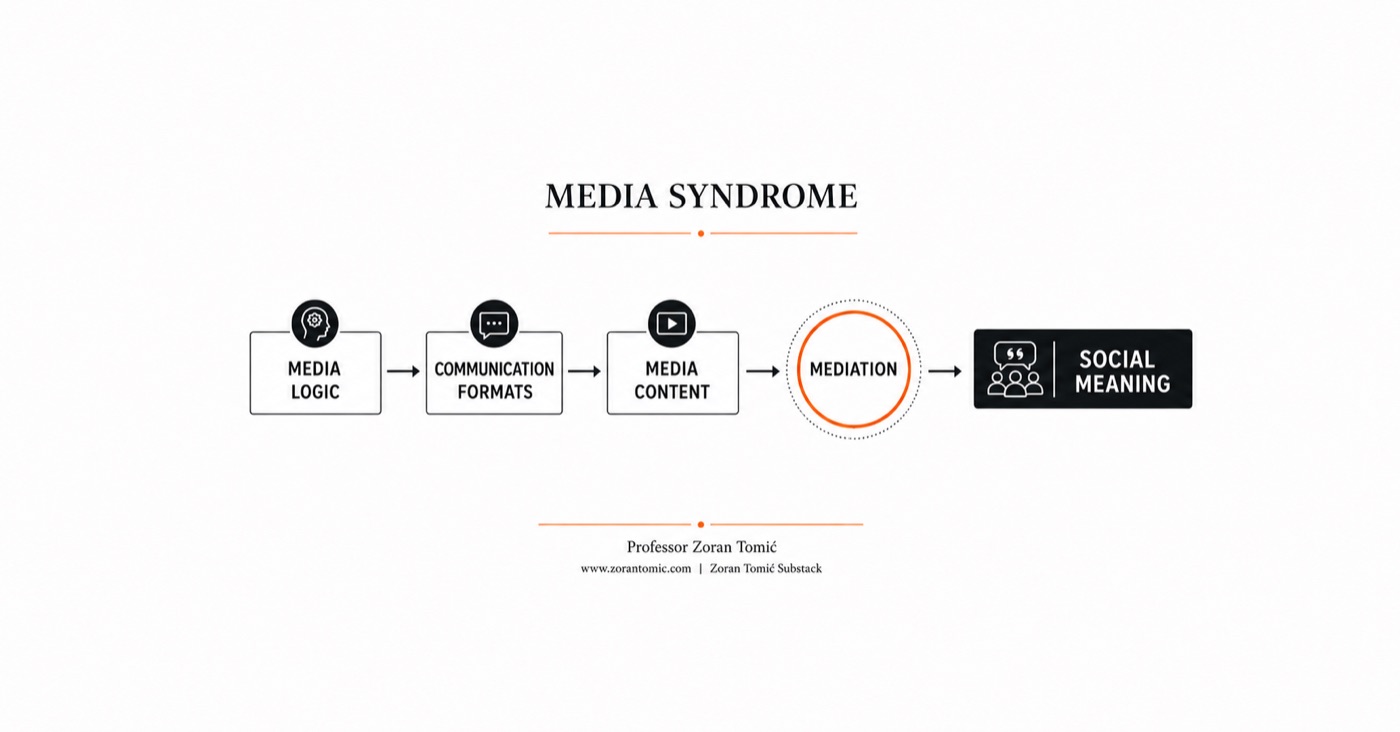
The development of mass media, digital communication technologies, and social networks over the past several decades has changed not only the speed and volume of available information. Far more important is the fact that media have gradually become an integral part of how individuals, organisations, and societies perceive, interpret, and construct reality. Media are no longer merely intermediaries transmitting information about events occurring outside them. Their formats, technologies, professional routines, and communication logic increasingly participate in shaping events themselves, their meanings, and their social consequences.
American sociologist and communication scholar David L. Altheide describes this complex process through the concept of the media syndrome. He systematically developed the concept in his book The Media Syndrome (2016), building on several decades of research into media logic, mass communication, political communication, fear, and social control. For Altheide, the media syndrome refers to the widespread presence of media logic, communication formats, and media content in social life. Its significance is therefore not limited to journalism or mass media but extends to politics, institutions, organisations, identities, social relations, public policies, and everyday behaviour (Altheide, 2016).
This understanding is based on the assumption that media influence not only what people think about but also how society recognises certain phenomena as events, problems, threats, or crises. From the perspective of the media syndrome, an event is not simply an objective fact that first occurs and is subsequently reported. Between the event and its social meaning lies a process of media mediation. Media select certain elements of an event, make them visible, organise them according to familiar formats, connect them with existing narratives, and present them to audiences, who then interpret them within their own cultural and social contexts.
For this reason, the media syndrome can be understood as a consequence of the gradual penetration of media principles into different areas of social life. Politics adapts to television and social media; organisations adapt events to the requirements of media visibility; politicians shape their performances according to the criteria of media appeal; and citizens increasingly understand social events through images, short videos, headlines, posts, and narratives produced by traditional and digital media.
Media Logic as the Foundation of the Media Syndrome
One of the key concepts for understanding the media syndrome is media logic, developed by Altheide and Snow in the late 1970s (Altheide & Snow, 1979). Media logic refers to how information is organised, shaped, and presented as a result of the characteristics of particular media and their professional, technological, and organisational rules.
Every medium possesses specific possibilities and limitations. Newspapers organise reality through text, headlines, photographs, sections, and the hierarchy of news. Television privileges images, sound, immediacy, action, drama, and short narrative forms. Social media add algorithmic selection, speed, interactivity, engagement metrics, personalisation, and the possibility of instantaneous content distribution.
Media logic therefore influences what can more easily become news, how an event will be presented, and which of its dimensions will be emphasised. Events characterised by strong visual elements, drama, conflict, emotional intensity, clearly identifiable protagonists, and the possibility of simple summarisation are more compatible with media formats than complex social processes requiring extensive explanation.
Altheide particularly emphasises several characteristics of events that are important for their media treatment: accessibility, visual quality, drama and action, audience relevance, encapsulation, and thematic unity (Altheide, 1985; 2016). The more closely an event corresponds to these criteria, the more likely it is to receive substantial media attention.
Media logic, however, should not be equated with the media syndrome. Media logic represents one of its key mechanisms. At the same time, the media syndrome is a broader social phenomenon that emerges when media logic, communication formats, and media content become deeply embedded in the functioning of society.
Mediation and the Construction of Meaning
Another key process is mediation. It describes how media participate in shaping the meaning of events and social phenomena. In this sense, media are not neutral mirrors of reality. Between what has happened and what audiences know about it lies a series of processes involving selection, interpretation, framing, visualisation, narrativization, and distribution.
The question is therefore no longer simply: What happened? Equally important questions are: How was the event presented? Which elements were selected? Which images were repeated? What words were used to describe it? Which interpretive frame became dominant? What was omitted? Moreover, ultimately, what meaning was produced?
This is one of the most important theoretical contributions of the media syndrome concept. The social significance of an event is determined not only by its objective magnitude but also by the degree of its media visibility and the meaning attributed to it through communication processes.
Altheide demonstrates this by comparing different political and international events. The 1968 U.S.S. Pueblo incident and the Iranian hostage crisis of 1979–1980 shared certain substantive similarities, yet they were very different media events. The reason lay not only in their political significance but also in technological change. The development of satellite television transmission enabled events in Iran to maintain a continuous visual presence before American audiences. A global event became almost an everyday local event entering viewers’ homes through television. Technology thus changed not only the way the crisis was reported but also the social experience of the crisis itself.
Ecology of Communication
Closely related to media logic is the concept of the ecology of communication. Altheide uses this concept to refer to the structure, organisation, and accessibility of information technologies, media, communication forums, and information channels at a particular social and historical moment.
The ecology of communication is particularly important because it emphasises that communication technology never exists in isolation. It operates within economic, political, cultural, and social relations, while simultaneously transforming those relations. The emergence of television, satellite transmission, the Internet, smartphones, or social media does not merely represent the appearance of a new means of communication. Each of these technologies changes the possibilities of communication, audience expectations, the speed of response, and how social reality becomes accessible.
Over the course of several decades, communication evolved from 16-mm film, which had to be physically transported and edited, through videotape and satellite transmission, to real-time digital communication. The consequences of this transformation extend far beyond technological progress. Contemporary communication has become increasingly immediate, visual, mobile, and personalised.
Social media represent another step in this process. Audiences are no longer merely recipients of professionally produced content. Individuals record, publish, comment on, share, and reinterpret events. In this context, Bennett and Segerberg (2013) refer to the logic of connective action, in which digital technologies enable more flexible forms of political and social association. Changes in the ecology of communication therefore transform the very nature of social participation.
Media Formats and the Production of Social Significance
The concept of the media syndrome is particularly useful for understanding that media attention is not simply a consequence of an event’s importance. The reverse process also operates: media visibility can produce the social significance of an event.
A television news story, for example, requires visual content, a relatively simple narrative structure, identifiable protagonists, time constraints, and a certain level of audience relevance and emotional appeal. Events are consequently adapted to communication formats. Their complexity is reduced to a limited number of elements that can be clearly presented and explained.
This is where what Altheide calls the news code emerges. Events are translated into a recognisable structure of news content. Over time, audiences internalise this code and begin to expect particular communication patterns. A feedback loop is thereby created: media shape audience expectations, while audience expectations subsequently influence how media produce content.
An especially important element of this process is visualisation. The development of television, satellite technology, digital video, and social media has increased the social power of the image. Events for which striking visual material exists can more easily become news, whereas complex processes without an attractive visual component may remain outside the centre of public attention.
This reveals one of the paradoxes of contemporary communication society: what is most visible is not necessarily what is most important, yet what becomes most visible may begin to appear as the most important.
Politics, Fear, and the Media Syndrome
Political communication is one of the areas in which the effects of the media syndrome can be seen most clearly. The Kennedy–Nixon televised debates of 1960 already demonstrated that political success would no longer depend solely on political programs, ideas, or rhetorical arguments. Appearance, manner of speaking, behaviour before the camera, and overall media presentation became elements of political evaluation.
Politics thus gradually adopted the logic of television. Candidates do not merely communicate political programs; they construct media-compatible political personae. Over time, even characteristics such as credibility, integrity, authority, and leadership ability have increasingly been evaluated through media performance.
Watergate provides another important example. Its significance lies not only in the political events that resulted in Nixon’s resignation but also in the fact that Watergate became an interpretive model for subsequent political scandals. The suffix “-gate” came to be applied to numerous later controversies. A single historical event thus evolved into a media code that suggests in advance how audiences should interpret a new event: as a scandal involving possible misconduct and potential concealment.
Altheide identifies a similar process in reporting on crises, terrorism, and wars. In these circumstances, the discourse of fear assumes a particularly important role. Media logic favours content characterised by drama, conflict, threat, and emotional intensity. The continuous repetition of such content can produce social perceptions of risk that are not necessarily proportional to its statistical or objective probability.
The Ebola epidemic provides an illustrative example. At one point, intense visual and emotional media representations of the disease substantially increased the perception of threat among the American public, even though the actual epidemiological risk to the U.S. population was very limited. As media attention diminished, Ebola virtually disappeared from the American information environment even though the health crisis in West Africa had not ended (Altheide, 2016).
The disappearance of media attention therefore does not necessarily mean that a problem has disappeared. Just as media visibility can increase the social significance of a phenomenon, media invisibility can reduce its perceived social significance.
The Media Syndrome in the Digital Age
Although Altheide developed his concept primarily through the analysis of television and mass media, it becomes even more relevant in the digital communication environment. Social networks, mobile devices, algorithmic content distribution, and the continuous availability of information have further blurred the boundaries between media and everyday life.
Media no longer exist merely “between” events and audiences. Media platforms have become spaces in which social events themselves take place. A political conflict may begin with a social media post; an organisational crisis can emerge from a viral video; a social movement can be organised through digital channels; their digital traces can shape an individual’s identity; and political or social legitimacy can become associated with visibility and recognition on global platforms.
For this reason, the media syndrome should not be understood simply as another traditional theory of “media effects.” Its proposition is stronger: media, their technologies, formats, and logic have become constitutive elements of social reality.
In the digital age, another dimension must therefore be added to this concept: algorithmic logic. In traditional mass media, journalists and editors largely determined the selection and hierarchy of news. In the digital environment, algorithms have become part of this process, determining which information becomes visible to individual users, in what order, and how frequently. Classical media logic is therefore being expanded by platform and algorithmic logics, while the media syndrome becomes even more deeply integrated into everyday life.
Conclusion
The media syndrome provides a useful theoretical concept for understanding contemporary communication society because it connects media logic, communication formats, information technology, mediation, and the social construction of meaning. Its fundamental value lies in recognising that media are not simply channels through which information is transmitted from sources to audiences. They participate in determining what becomes visible, relevant, dramatic, and socially significant.
In this sense, the media syndrome describes a condition in which media logic extends beyond media organisations themselves and becomes embedded in politics, institutions, organisations, culture, and everyday life. Politicians adapt their behaviour to media formats; institutions construct events according to the criteria of media visibility; audiences interpret social reality through familiar media narratives; and digital platforms and algorithms increasingly determine what becomes visible and important.
The concept therefore opens a broader question concerning the relationship between communication, meaning, and power. Those who can influence the selection of information, its framing, visualisation, repetition, and distribution affect not only media content but also how social actors understand particular events. In this respect, Altheide’s concept approaches the contemporary understanding of communication as a process of constructingand managing meaning.
The media syndrome can therefore be concisely defined as a socio-communicative condition in which media logic, communication formats, and information technologies become integral to how events are shaped, represented, interpreted, and transformed into socially relevant meanings.
Such a definition makes it possible to apply the concept beyond Altheide’s original analyses of American mass media. In contemporary digital society, the media syndrome encompasses traditional media, social media, digital platforms, and algorithmic systems—that is, the entire communication infrastructure through which visibility, interpretations, and social meanings are produced today. For precisely this reason, the concept may have particular value for contemporary communication studies, public relations, and research into the processes of meaning management.