Public relations is entering a new stage of its development.
This transformation is often described primarily through technological change: digital platforms, social media, algorithms, data analytics, automation, and artificial intelligence. These technologies are undoubtedly reshaping the tools, speed, reach, and operational practices of public relations. However, PR 4.0 cannot be reduced to introducing new technologies into an existing professional model.
PR 4.0 represents a deeper transformation in how we understand communication, organisations, publics, and the professional responsibility of public relations practitioners.
Earlier paradigms of public relations were primarily concerned with publicity, the dissemination of information, persuasion, dialogue, and relationship management. PR 4.0 does not entirely reject these functions. Instead, it incorporates and extends them within a more complex communication environment shaped by digital platforms, artificial intelligence, fragmented publics, competing interpretations, and declining institutional trust.
Organisations today do not communicate in a stable environment in which messages move predictably from sender to receiver. Their statements, decisions, and actions enter a dynamic interpretive space. They are immediately analysed, compared, challenged, reframed, emotionally evaluated, and redistributed by numerous actors.
Communication has therefore become a struggle not only for attention, but also for meaning.
This is why the central task of PR 4.0 is no longer simply to distribute information, achieve visibility, or maintain relationships. Its emerging responsibility is to help organisations and their publics create shared understanding, navigate competing interpretations, build trust, and preserve social legitimacy.
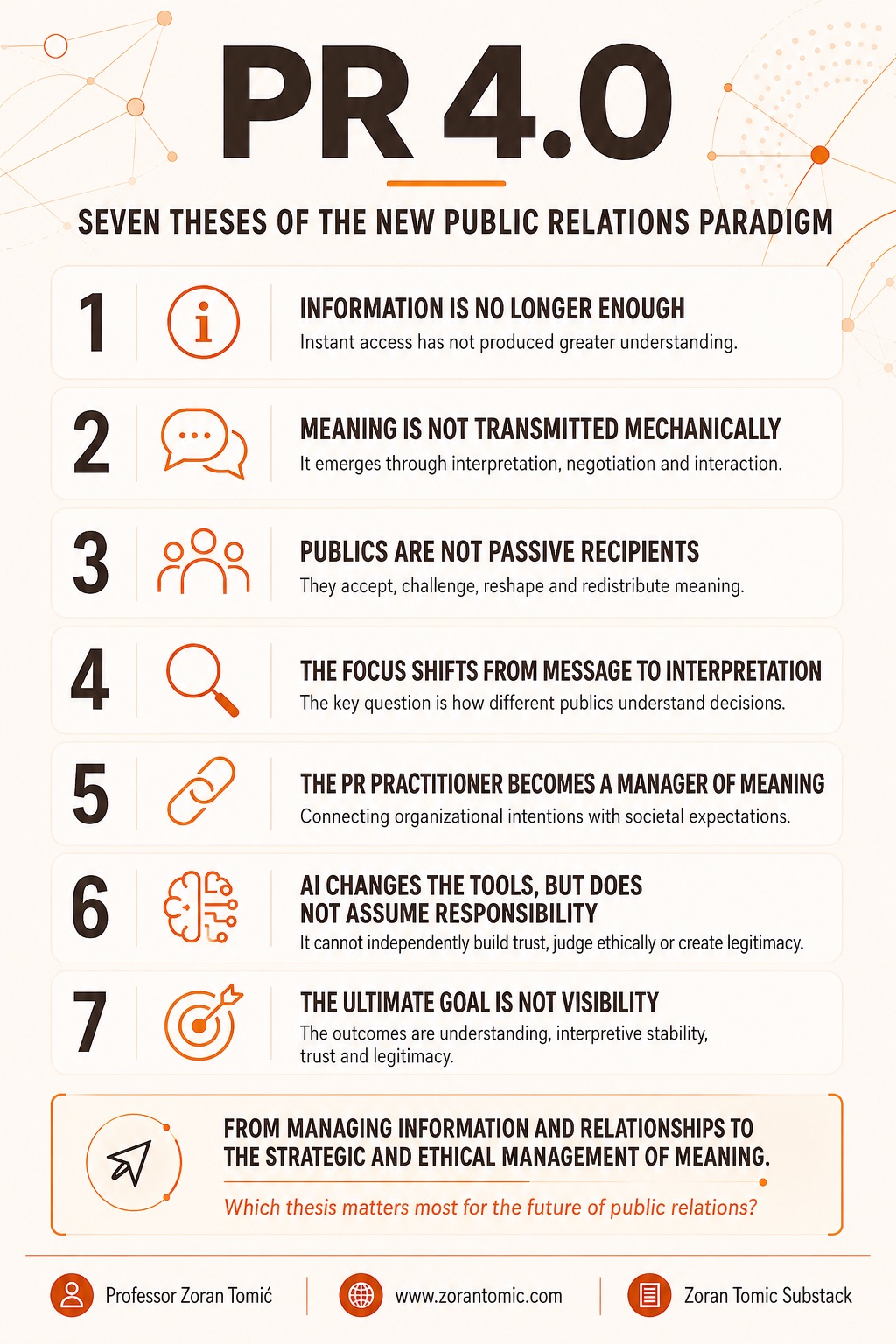
I summarise the PR 4.0 paradigm in seven fundamental theses.
1. Information is no longer enough
For most of the history of public relations, access to information represented an important source of organisational power. Organisations controlled what information would be released, when it would be released, and through which channels it would reach the public.
That environment has fundamentally changed.
Information is now instantly accessible, continuously produced, and distributed through countless communication channels. Organisations, journalists, employees, citizens, activists, influencers, algorithms, and artificial intelligence systems all participate in its production and circulation.
Yet the abundance of information has not necessarily created better-informed societies.
We have never had access to more information, but we continue to face misunderstanding, polarisation, uncertainty, manipulation, and distrust. More information does not automatically produce more knowledge, just as more communication does not automatically produce more understanding.
The problem is no longer simply the lack of information. The problem is the absence of context, interpretation, relevance, credibility, and meaning.
An organisation may publish accurate data and still fail to explain why that data matters. It may issue a technically correct statement and still be misunderstood. It may communicate frequently and remain emotionally and socially distant from its publics.
PR 4.0 therefore begins with a fundamental realisation: information is necessary, but it is no longer sufficient.
The value of communication does not depend only on how much information has been distributed. It depends on whether people can understand it, place it within a meaningful context, connect it to their experience, and determine whether the source deserves their trust.
2. Meaning is not transmitted mechanically
Traditional communication models often represent communication as the transmission of a message from a sender to a receiver. Although useful for explaining certain technical aspects of communication, this model can create the misleading impression that meaning travels inside a message and arrives unchanged at its destination.
Meaning does not function in this way.
Organisations can transmit words, images, data, symbols, and narratives, but they cannot fully control the meanings that publics will assign to them. Meaning emerges through interpretation.
Every message is interpreted within a particular social, cultural, political, emotional, and historical context. The same organisational decision may be perceived by one group as necessary, by another as unfair, by a third as innovative, and by a fourth as evidence of institutional irresponsibility.
This means that communication is not merely a process of transmission. It is a process of interpretation, negotiation, and interaction.
Meaning is created in the space between what an organisation intends to communicate and how its publics understand what has been said or done.
This interpretive space is central to PR 4.0.
The role of public relations is therefore not to impose a single meaning or manipulate public interpretation. Its role is to recognise different perspectives, explain organisational intentions, understand public concerns, reduce harmful ambiguity, and create conditions in which more stable and credible meanings can emerge.
3. Publics are not passive recipients
Digital communication has made visible what public relations theory has long suggested: publics are not passive audiences waiting to receive organisational messages.
They are active participants in the communication process.
Publics accept, reject, question, reinterpret, transform, and redistribute the meanings of organisational decisions. They create their own content, share personal experiences, organise communities, challenge institutional narratives, and influence how other people understand an organisation.
A statement published by an organisation is therefore no longer the end of communication. It is often only the beginning of a much broader interpretive process.
Once released, a message may be quoted outside its original context, turned into a headline, discussed by employees, analysed by experts, criticised by activists, transformed into a meme, summarised by artificial intelligence, and circulated globally within minutes.
In such an environment, organisations do not possess exclusive ownership of their narratives.
This does not mean that organisations have become powerless. It means that their communication power must be understood differently. Credibility no longer comes primarily from controlling information. It increasingly comes from openness, consistency, responsiveness, ethical conduct, and the capacity to engage meaningfully with different publics.
PR 4.0 recognises publics as co-creators of meaning. They are not communication targets but interpretive actors whose experiences, expectations, emotions, and values shape organisational reality.
Listening therefore becomes as important as speaking. Understanding becomes as important as informing. Participation becomes as important as presentation.
4. The focus of public relations is shifting from the message to interpretation
Public relations has traditionally devoted considerable attention to messages: how they are written, framed, presented, distributed, and repeated.
These activities remain important, but they are no longer enough.
A perfectly written message can fail if it is interpreted differently from what the organisation intended. A communication campaign can achieve enormous visibility and still damage trust. A statement can be factually correct yet socially insensitive. A message can reach millions of people without producing genuine understanding.
The central question of PR 4.0 is therefore not only:
What did the organisation say?
It is also:
How did different publics understand what the organisation said and did?
This shift from message to interpretation changes how communication effectiveness should be evaluated.
The number of impressions, media mentions, clicks, views, and reactions can tell us whether a message was visible. They cannot, by themselves, tell us whether the message was understood, believed, accepted, contested, or considered legitimate.
Communication measurement must consequently move beyond exposure and engagement. It must also examine interpretive outcomes:
- What meanings did publics associate with the organisation’s decision?
- Where did misunderstanding emerge?
- Which interpretations gained social influence?
- Did the communication strengthen or weaken trust?
- Did it reduce uncertainty or create additional confusion?
- Did organisational words correspond with organisational behaviour?
In PR 4.0, successful communication is not defined merely by the delivery of a message. It is defined by the quality and consequences of the interpretations that follow.
5. The public relations practitioner is becoming a manager of meaning
The changing communication environment requires a new understanding of the professional role of public relations practitioners.
The practitioner can no longer be viewed primarily as a producer of messages, media relations specialist, content creator, or manager of communication channels. These functions remain part of the profession, but many of them are increasingly supported or automated by intelligent technologies.
The strategic value of the practitioner lies elsewhere.
The public relations practitioner is becoming a manager of meaning.
The manager of meaning operates at the intersection of organisational identity, organisational intentions, public expectations, social values, and competing interpretations. Their task is to understand how organisational decisions acquire meaning and how those meanings influence trust, relationships, reputation, and legitimacy.
This does not mean controlling how everyone thinks. Meaning management must not become a new term for manipulation.
Ethical meaning management is based on listening, interpretation, dialogue, contextualisation, explanation, responsibility, and respect for the autonomy of publics. Its purpose is not to manufacture consent but to make organisational action more understandable, socially responsible, and open to legitimate public evaluation.
The manager of meaning helps an organisation answer several essential questions:
- Who are we as an organisation?
- What do our decisions communicate about us?
- How are different publics likely to interpret our actions?
- Where is the gap between our intentions and public perceptions?
- Which interpretations are based on misunderstanding, and which reveal genuine organisational failures?
- How can we respond without denying public experience?
- What must change in our communication, and what must change in our behaviour?
This role places public relations closer to the centre of organisational decision-making. Communication cannot repair indefinitely what irresponsible leadership, unethical conduct, or inconsistent behaviour continually damages.
The manager of meaning must therefore influence not only what an organisation says, but also how it listens, decides, behaves, and accepts responsibility.
6. Artificial intelligence is changing the tools, but it does not assume responsibility
Artificial intelligence is already transforming public relations.
It can analyse large quantities of data, identify emerging issues, monitor public sentiment, generate content, personalise messages, simulate scenarios, translate languages, predict communication risks, and support strategic decision-making.
These capabilities will continue to develop.
However, the growing power of artificial intelligence makes it necessary to distinguish between technical capability and professional responsibility.
AI can generate a crisis statement, but it cannot independently assume moral responsibility for the crisis. It can analyse emotional reactions, but it does not genuinely experience empathy. It can recommend an efficient communication strategy, but it cannot decide on its own whether that strategy is ethically justified. It can imitate the language of trust, but it cannot build trust independently of human behaviour and organisational integrity.
Trust, legitimacy, empathy, accountability, and ethical judgment remain fundamentally human and institutional responsibilities.
This is one of the central paradoxes of PR 4.0: as communication technologies become more intelligent, the human responsibility of communication professionals becomes more important.
Public relations practitioners must understand both the possibilities and limitations of artificial intelligence. They must know when AI can improve communication and when human judgment must prevail. They must protect transparency, privacy, accuracy, fairness, and human dignity.
AI can support the manager of meaning, but it cannot replace the ethical responsibility attached to that role.
The central question is therefore not whether artificial intelligence will transform public relations. It already has. The more important question is whether the profession will use artificial intelligence to deepen understanding or merely to accelerate content production.
7. The ultimate goal of PR 4.0 is not visibility
Visibility has become one of the dominant currencies of digital communication.
Organisations compete for attention, media presence, search results, followers, views, likes, shares, and algorithmic reach. However, visibility should not be confused with communication success.
An organisation can be highly visible and deeply distrusted.
It can dominate public discussion and simultaneously lose legitimacy. It can generate millions of interactions without creating meaningful relationships. It can attract attention through controversy while weakening its long-term reputation.
The ultimate goal of PR 4.0 is therefore not visibility.
Its more important outcomes are understanding, interpretive stability, trust, and legitimacy.
Understanding exists when publics can recognise the meaning, context, and consequences of organisational decisions, even when they do not fully agree with them.
Interpretive stability does not mean the elimination of disagreement. It refers to a condition in which communication is sufficiently clear, consistent, and credible that destructive confusion and uncontrolled ambiguity do not dominate public interpretation.
Trust emerges when organisational words and actions demonstrate competence, integrity, reliability, and concern for stakeholders.
Legitimacy exists when an organisation’s presence, decisions, and conduct are perceived as appropriate and acceptable within society’s values and expectations.
These outcomes cannot be created through communication alone. They depend on the relationship between communication and conduct.
PR 4.0 must therefore connect words with decisions, narratives with behaviour, technological innovation with human responsibility, and organisational interests with societal expectations.
From communication management to meaning management
The seven theses point towards a broader transformation of public relations.
PR 4.0 does not abandon information, persuasion, dialogue, or relationship management. It builds upon them and places them within a more demanding interpretive environment.
Information must lead to understanding.
Dialogue must include genuine listening.
Relationships must be grounded in trust.
Technology must remain connected to responsibility.
Visibility must contribute to legitimacy.
The public relations practitioner of the future will not be valued primarily for producing more content than artificial intelligence. The profession’s distinctive value will lie in its ability to understand people, interpret complex social contexts, connect different perspectives, recognise ethical consequences, and help organisations act responsibly.
For this reason, PR 4.0 can be expressed in one central sentence:
PR 4.0 represents a transition from managing information and relationships to the strategic and ethical management of meaning.
The future of public relations will not be determined only by new communication technologies. It will be determined by whether organisations and communication professionals can use those technologies to create greater understanding, stronger trust, and more legitimate relationships with society.
Which of these seven theses do you consider the most important for the future of public relations?
Professor Zoran Tomić www.zorantomic.com Zoran Tomic Substack
#PR40 #MeaningManagement #ManagerOfMeaning #ArtificialIntelligence #PublicRelations #ZoranTomic