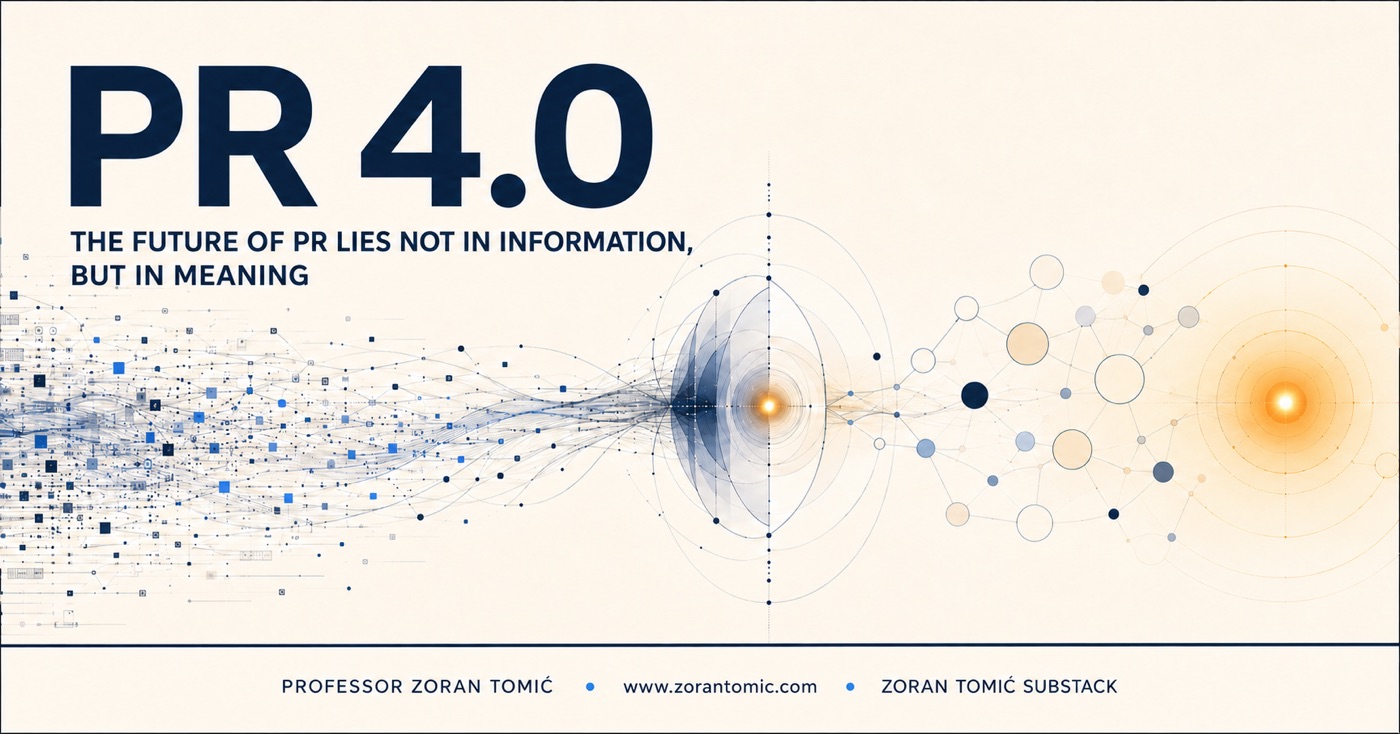
Never in human history has information been more accessible than it is today.
Within seconds, artificial intelligence can produce text, images, analyses, presentations, or communication strategies. Social media enable organisations to address millions of people instantly. Digital platforms have removed many of the communication barriers that once existed, while algorithms continuously select, classify, and distribute content.
Today, organisations can communicate faster, more frequently, and more directly than ever before.
However, one question is becoming increasingly urgent:
If we have so much information, why do we have less and less shared understanding?
Information abundance has not produced stability of meaning. On the contrary, it has multiplied possible interpretations, accelerated their circulation, and created space for the continuous contestation of almost every organisational decision.
The same message may be understood as responsibility or manipulation, transparency or concealment, innovation or threat, solidarity or an attempt to repair a damaged reputation. An organisation may carefully prepare its message, but it can no longer determine its ultimate meaning.
It is precisely within this gap between the information produced and its public interpretation that space opens for a new phase in the development of public relations—PR 4.0.
Communication Is No Longer the Same as Understanding
The traditional understanding of communication long rested on a relatively simple assumption: an organisation produces a message, selects a communication channel, and transmits information to a particular public.
Success was most often assessed by determining whether the message had reached its recipients, how many people had seen the content, how many times it had appeared in the media, or what kind of reaction it had generated.
Today, such an understanding is no longer sufficient.
A message that reaches one million people has not necessarily produced understanding. High visibility does not necessarily create trust. Media presence does not guarantee reputation, and the volume of content does not ensure social legitimacy.
Organisations therefore no longer face only the question:
How do we transmit information?
Their much greater challenge is becoming:
How will different publics understand our decisions, actions, and intentions?
This is the central question of PR 4.0.
The focus of communication is shifting from producing messages to interpreting them. It is no longer sufficient to manage what an organisation says. It is necessary to understand how its words and actions acquire meaning within different social, cultural, and digital contexts.
From Publicity to Meaning
The development of public relations can be understood as a gradual expansion of the profession’s primary field of concern.
PR 1.0 was predominantly associated with publicity, attention generation, and media visibility. Its historical logic was the logic of appearing in public.
PR 2.0 placed greater emphasis on information. Organisations were expected to provide their publics with timely, accurate, and relevant information.
PR 3.0 shifted attention to two-way communication, public opinion research, dialogue, and managing relationships between organisations and their publics. The development of the internet further expanded the possibilities for this form of communication.
PR 4.0emerges amid artificial intelligence, digitalisation, social media, algorithmic mediation, and information hyperproduction. It does not abolish previous paradigms but expands and builds upon them.
Organisations still need publicity, information, and high-quality relationships. However, the contemporary communication environment requires an understanding of another, deeper level: the processes through which particular meanings are attributed to organisational decisions, identities, and actions.
This developmental logic can therefore be summarised as follows:
PR 1.0 – Publicity Management
PR 2.0 – Information Management
PR 3.0 – Relationship Management
PR 4.0 – Meaning Management
Meaning Cannot Simply Be Sent.
Information can be shaped, encoded, and transmitted.
Meaning is more complex.
It is not permanently contained within a message, nor does it pass mechanically from sender to recipient. Meaning emerges through the encounter between a message and the public’s previous experiences, values, identities, emotions, cultural patterns, and expectations.
For this reason, different groups may attribute entirely different meanings to the same organisational decision.
For management, a restructuring decision may represent necessary modernisation; for employees, uncertainty; for investors, the rationalisation of operations; and for the local community, the loss of jobs. The decision itself is not sufficient to determine its public meaning. That meaning emerges through processes of interpretation, communication, negotiation, and social evaluation.
Publics are not passive recipients of organisational messages. They comment on them, reshape them, contest them, and connect them with other experiences. They create their own narratives, symbols, memes, and interpretive communities.
An organisation can offer a framework for understanding, but it cannot fully control how its actions will be interpreted.
Meaning management must therefore not be understood as controlling people’s thoughts. It is not a new term for propaganda, manipulation, or perception management.
Rather, it is an organisation’s strategic and ethical capacity to understand existing interpretations, explain its own actions, identify misunderstandings, enable dialogue, and connect its decisions with legitimate societal expectations.
The Public Relations Professional as a Manager of Meaning
If an organisation’s fundamental challenge is shifting from distributing information to interpreting its actions, then the role of the public relations professional must also change.
Within the PR 4.0 paradigm, the public relations professional is no longer merely a writer of press releases, an organiser of press conferences, a social media manager, or an intermediary between the organisation and the media.
The public relations professional becomes a manager of meaning.
A manager of meaning first helps the organisation understand itself. They participate in the internal process through which the organisation explains its decisions, identity, values, and purpose to itself.
The manager of meaning then connects organisational intentions with the interpretations of different publics. They identify potential discrepancies between what the organisation wishes to represent and how its publics actually perceive it.
The manager of meaning asks questions that must precede the production of communication content:
- What does this decision mean to employees?
- How will it be understood by users, partners, or the local community?
- Is organisational behaviour aligned with the messages we communicate?
- What competing interpretations are already emerging?
- Is there a risk that the organisation’s intention will be understood in an entirely different way?
- Can we explain our actions publicly and defend them ethically?
- Does our communication build long-term trust or merely short-term visibility?
Such a role requires the public relations professional to be involved in the decision-making process before a decision becomes a communication problem.
Meaning is not shaped only after a decision has been made. It emerges alongside the decision itself.
The manager of meaning must therefore serve as a strategic adviser to senior management, rather than merely as an operational executor of decisions that have already been made.
Artificial Intelligence Does Not Diminish the Importance of PR
The development of artificial intelligence will not eliminate public relations, but it will transform the profession’s centre of gravity.
A significant proportion of technical and operational tasks can be automated. Artificial intelligence can already write texts, monitor media coverage, analyse audience reactions, identify communication patterns, and suggest responses.
However, AI cannot independently assume social responsibility for an organisational decision. It cannot determine what is legitimate, just, and worthy of trust within a particular social context. Nor can it replace people in reconciling organisational interests with the public’s moral expectations.
Technology can accelerate the production of messages, but it cannot create credibility on its own.
It can analyse existing interpretations, but it cannot assume full responsibility for their social consequences.
This is precisely why artificial intelligence increases the need for managers of meaning. The more content technology produces, the more important the human capacity becomes to distinguish the relevant from the irrelevant, the authentic from the artificially produced, the legitimate from the manipulative, and the meaningful from the communicatively empty.
Visibility Is Not the Ultimate Goal
Professional communication is often evaluated according to reach, views, media coverage, reactions, and other easily measurable indicators.
These data are important, but they do not tell us enough about the actual effects of communication.
An organisation can be highly visible and, at the same time, lack credibility. It can communicate every day while being increasingly misunderstood by its publics. It can achieve millions of views and still lose trust.
The ultimate goal of PR 4.0 is therefore not visibility alone.
Its most important outcomes are:
understanding, interpretive stability, trust, and legitimacy.
Interpretive stability does not mean that everyone must think in the same way about an organisation. That would be neither possible nor desirable. It means that, over time, an organisation acts with sufficient consistency, clarity, and responsibility for its publics to recognise who it is, what it stands for, and why it makes particular decisions.
Trust emerges when messages, decisions, and behaviour reinforce one another.
Legitimacy emerges when publics perceive an organisation’s actions not only as effective, but also as socially acceptable, justified, and worthy of support.
Is It Time for PR 4.0?
With the publication of the scientific article The Manager of Meaning in Contemporary Public Relations, I have sought to open a discussion that extends beyond the boundaries of a single article.
The paper’s central thesis is that contemporary public relations can be understood as an institutionalised practice of meaning management, and the public relations professional as a manager of meaning.
This is not a claim that the profession’s development is complete or that previous models are no longer important. It invites reflection on a transformation already underway.
Information remains important. Communication channels remain important. Relationships with publics remain the foundation of the profession.
However, in an age of artificial intelligence, algorithms, and competing interpretations, it is no longer sufficient to ask only what we communicated and how many people we reached.
We must ask:
What do our words and decisions mean to people?
PR 4.0 begins with that very question.
In my next article, I will present the seven fundamental theses of PR 4.0 and seek to define its theoretical, professional, and ethical framework more precisely.
Until then, one question remains open:
Is it time to begin understanding public relations as meaning management?