Abstract
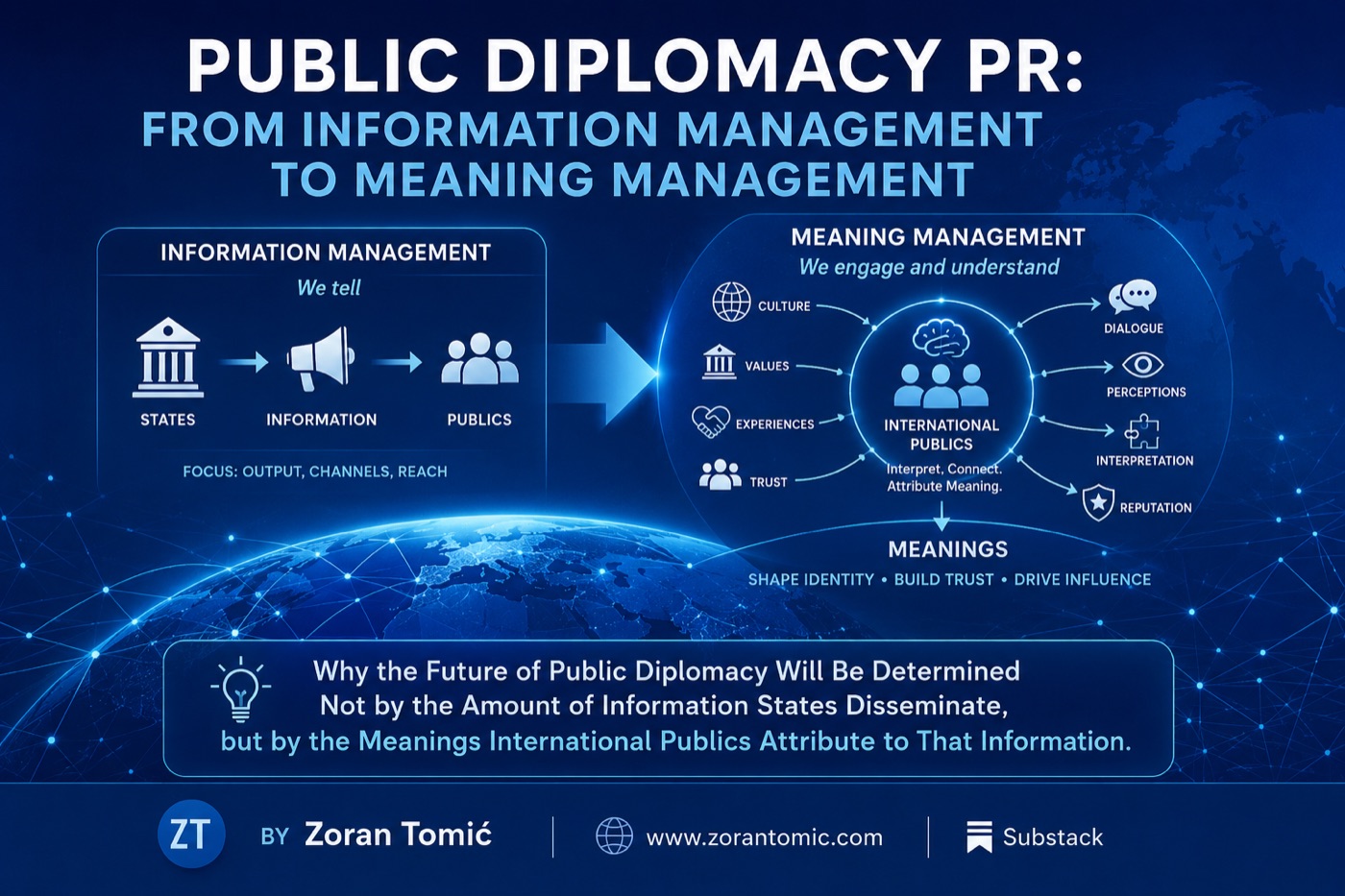
Contemporary public diplomacy is undergoing a profound transformation driven by the digitalisation of communication, the rise of social media and global media platforms, and the advent of artificial intelligence. Within this evolving communication environment, the traditional understanding of public diplomacy as a process of international information dissemination and the promotion of national interests is no longer sufficient to explain how states achieve international influence. This paper examines the evolution of public diplomacy from information-oriented models toward an approach that places the processes of interpretation and meaning formation among international publics at its core. Drawing upon key theoretical perspectives in public diplomacy, public relations, strategic communication, and soft power, the paper argues that international publics are no longer passive recipients of diplomatic messages but active participants who construct their own meanings through communication processes. Based on this theoretical analysis, the paper proposes an expanded definition of public diplomacy that, in addition to information dissemination, dialogue, and relationship building, encompasses the strategic shaping of the conditions under which international publics develop meanings associated with a state’s identity, values, policies, and international actions. The paper concludes that the future effectiveness of public diplomacy will depend less on the quantity of information produced by states and more on their capacity to understand and strategically influence the processes through which international publics construct perceptions, trust, reputation, and international influence.
**Keywords:**public diplomacy, public relations, strategic communication, meaning, meaning construction, international perceptions, national reputation, soft power, international trust.
1. Introduction
In the first quarter of the twenty-first century, public diplomacy has been undergoing one of the most significant transformations since its emergence as a distinct field of international communication. Globalisation, digital communication, the proliferation of social media, artificial intelligence, and the growing influence of global media platforms have fundamentally reshaped how states communicate with foreign publics. Diplomatic communication is no longer confined to official channels, diplomatic notes, and international conferences. Today, a state’s image and international standing are shaped simultaneously by political statements, media coverage, cultural products, economic activities, the actions of international organisations, digital platforms, and millions of individual interactions on social media.
This transformed communication environment has opened a new chapter in the evolution of public diplomacy. The traditional assumption that international understanding is primarily achieved through the effective dissemination of information and efficient communication is no longer sufficient to explain contemporary international relations. Although states possess more communication tools and channels than ever before, they are finding it increasingly difficult to build trust, credibility, and international influence. Information has become globally accessible; however, its availability alone does not guarantee shared understanding or a favourable perception of the state that communicates it.
This reality is particularly evident during international crises, armed conflicts, and geopolitical tensions. Almost every major international event generates multiple and often competing interpretations that vie for the attention and trust of international publics. The same political event may be framed as the defence of international law, an act of aggression, a humanitarian intervention, or the legitimate protection of national interests, depending on the interpretative framework through which different publics perceive it. Under such circumstances, international influence depends less on the availability of information and more on the meanings that international publics attribute to it.
Consequently, public diplomacy can no longer be understood merely as a process of disseminating information or promoting national interests. Its role has become considerably more complex. It encompasses the development of trust, the cultivation of long-term relationships, the management of international reputation, the construction of credible narratives, and an understanding of how diverse publics interpret political messages, national identity, and states’ international actions. In other words, the focus of contemporary public diplomacy is gradually shifting from communication itself to the processes through which international publics construct their understanding of states and their actions.
For this reason, contemporary public diplomacy increasingly draws upon the theoretical foundations and practical principles of public relations. Relationship building, reputation management, trust development, strategic communication, and a deep understanding of diverse publics have become integral components of diplomatic practice. As a result, public diplomacy has progressively converged with contemporary public relations, blurring the traditional boundaries between the two disciplines.
Against this background, this paper argues that the future of public diplomacy will be determined not primarily by the quantity of information produced by states or the intensity of their international communication, but by their capacity to understand and shape the meanings that international publics attribute to that information. Rather than challenging existing theories of public diplomacy, the paper seeks to demonstrate that the contemporary communication environment calls for their extension through a perspective that places interpretation, perception, and meaning construction at the centre of analysis. From this perspective, public diplomacy is reconsidered as a strategic communication process in which a state’s success depends not only on what it communicates but also on how its messages become embedded within broader systems of meaning that shape international trust, reputation, and influence.
2. The Evolution of Public Diplomacy: From Information Dissemination to the Shaping of International Perceptions
Over the past several decades, public diplomacy has undergone a significant conceptual transformation. While its early development was primarily concerned with international information dissemination and the promotion of national interests among foreign publics, it is now increasingly understood as a complex process of building relationships, fostering trust, and enhancing international credibility. Changes in the global communication environment, the rapid development of digital technologies, and the growing influence of non-state actors have expanded the scope of public diplomacy far beyond traditional diplomatic practice.
Unlike traditional diplomacy, which is primarily based on communication between states and their official representatives, public diplomacy is directed toward foreign publics. Its objective is not merely to explain a state’s foreign policy but to foster long-term understanding, trust, and cooperation with citizens, the media, academia, the business community, and other international stakeholders (Melissen, 2005). Consequently, international publics have become active participants in international relations rather than passive observers of diplomatic activities.
Early models of public diplomacy were predominantly information-oriented. They were based on the assumption that credible and timely dissemination of information would contribute to a better understanding of a state’s political objectives and values. This approach was particularly characteristic of the Cold War period, when international broadcasting, cultural exchanges, and public information programs constituted key instruments of international influence. At the centre of the communication process stood the message that a state sought to convey to foreign publics.
The development of public diplomacy was closely linked to the broader evolution of states’ international communication. Skoko (2004) argues that the instruments of international influence gradually evolved from propaganda-based models toward contemporary public relations and public diplomacy, whereby communication increasingly assumed the characteristics of dialogue, credibility-building, and the development of international trust. This transformation marked a shift away from one-way political persuasion toward communication founded on long-term relationships with international publics.
The emergence of contemporary public diplomacy theory has significantly reshaped the understanding of its fundamental purpose. Cull (2009) argues that public diplomacy can no longer be effective if it relies exclusively on one-way information transmission. Among the core components of contemporary public diplomacy, he identifies listening as a fundamental function, emphasising the systematic understanding of the needs, expectations, and perceptions of international publics. Communication thus ceases to be a process of unilateral persuasion and becomes a process of mutual understanding.
A similar perspective is advanced by Melissen (2005), who conceptualises contemporary public diplomacy as a continuous process of dialogue and long-term relationship building between states and international publics. In his view, the effectiveness of public diplomacy depends not solely on the quality of communication messages but on a state’s ability to establish credible and enduring relationships grounded in trust and mutual understanding. Such an approach brings public diplomacy into close alignment with the fundamental principles of contemporary public relations.
The concept of soft power represents a further theoretical advancement. Nye (2004) demonstrates that international influence is increasingly derived not from military or economic strength but from a state’s capacity to attract through its values, culture, political institutions, and foreign policy. Attraction thus becomes a critical source of international influence, as foreign publics cannot be compelled to accept a particular image of a state; rather, their trust and confidence must be earned.
The development of digital communication technologies has further transformed the nature of public diplomacy. Social media, global media platforms, and artificial intelligence have enabled the instantaneous dissemination of information while simultaneously multiplying the number of actors involved in shaping international perceptions. Governments are no longer the sole producers of international narratives. Today, the image of states is influenced by international media organisations, non-governmental organisations, multinational corporations, influencers, academic institutions, cultural industries, and ordinary citizens who actively participate in international communication through digital platforms (Castells, 2009).
Within this communication environment, international publics are no longer passive recipients of diplomatic messages. They compare information with their own experiences, cultural frameworks, value systems, and pre-existing narratives. As a result, identical diplomatic initiatives may generate significantly different—and sometimes even contradictory—perceptions across different parts of the world. This shift represents one of the defining characteristics of contemporary public diplomacy.
It can therefore be concluded that the evolution of public diplomacy is reflected not merely in the development of new communication tools or the increasing volume of international information. More fundamentally, it lies in a transformation of the very nature of international communication. Contemporary public diplomacy is becoming progressively less dependent on the assumption that information alone produces understanding and increasingly based on the recognition that international publics actively interpret communication and construct their perceptions of states, their values, and their international actions through these interpretative processes. This insight opens the way for a renewed understanding of public diplomacy in which the central question is no longer simply what states communicate, but how international publics understand, interpret, and evaluate the meanings that emerge from that communication.
3. Public Relations as the Communication Foundation of Public Diplomacy
The contemporary development of public diplomacy cannot be fully understood without considering the theoretical and practical contributions of public relations. Although public diplomacy and public relations evolved within different institutional and professional contexts, both disciplines share a common objective: building high-quality, long-term relationships between an organisation or a state and its publics. Consequently, an increasing number of scholars have highlighted the conceptual convergence and growing interdependence between the two (Signitzer & Coombs, 1992).
Traditionally, public diplomacy focused on representing the state internationally and explaining its foreign policy to foreign publics. In contrast, contemporary public relations has developed theoretical frameworks that emphasise dialogue, mutual understanding, trust, and long-term relationship building. These developments have significantly influenced public diplomacy, which has gradually shifted from one-way communication models to approaches grounded in interaction, participation, and collaboration.
A particularly influential contribution was made by Grunig (1992) with the Excellence Theory, which argues that effective communication is not based on one-way persuasion but on two-way symmetrical communication, listening, and adapting communication activities to the expectations of diverse publics. This approach provides an important theoretical foundation for contemporary public diplomacy, as international publics are no longer regarded as passive recipients of diplomatic messages but as active participants in the communication process.
The development of relationship management theory further reinforced this shift. Ledingham (2003) argues that the success of public relations cannot be measured solely by media visibility or the volume of communication activities but rather by the quality of the relationships an organisation establishes with its publics. Trust, credibility, satisfaction, and mutual understanding thus become the principal indicators of effective communication. Increasingly, these same criteria are also defining the effectiveness of public diplomacy.
The conceptual relationship between public diplomacy and public relations has attracted growing scholarly attention in recent years. Skoko (2021) argues that, despite their different institutional origins, the two disciplines increasingly overlap in relationship-building, trust-building, reputation management, and international credibility. Examining their interrelationship, he concludes that contemporary public diplomacy is increasingly adopting the theoretical and methodological foundations of public relations, particularly in strategic communication and relationship management with international publics.
The emergence of strategic communication has further expanded the role of public relations within public diplomacy. Hallahan et al. (2007) define strategic communication as the planned coordination of all communication activities in pursuit of long-term organisational objectives. In the context of public diplomacy, this means that international communication is no longer understood as a collection of isolated diplomatic activities but as an integrated process in which political communication, media relations, cultural diplomacy, public engagement, digital communication, and nation branding function as mutually reinforcing elements of a coherent communication strategy.
These developments demonstrate that contemporary public diplomacy has embraced many of the fundamental principles of public relations. Today, its core concepts include relationships, reputation, trust, dialogue, credibility, and strategic communication. However, the transformation of the digital communication environment raises a new question that classical public relations theories have not fully addressed. Even when a state succeeds in establishing strong relationships, building credibility, and engaging in meaningful dialogue with international publics, a crucial question remains: how do these publics interpret communication, and what meanings do they construct from it?
At this point, a new stage in the evolution of public diplomacy begins to emerge. In the digital society, communication effectiveness can no longer be assessed solely by the number of published messages, the reach of communication campaigns, or the quality of stakeholder relationships. A state’s international influence increasingly depends on the interpretations that emerge within international publics and on how these interpretations shape perceptions of its identity, values, credibility, and international role. Consequently, the focus gradually shifts from how to communicate to the more fundamental question of what international publics actually understand from communication.
This transformation does not diminish the importance of existing public relations theories. On the contrary, it confirms their continuing relevance while simultaneously highlighting the need for their further development in response to the challenges of the contemporary communication environment. If public relations has evolved through theories of information dissemination, dialogue, and relationship management, then contemporary public diplomacy opens a new avenue for understanding how international publics interpret communication and how these interpretations shape long-term perceptions of states and their role in international affairs.
4. Why Information Is No Longer Enough
The contemporary communication environment has fundamentally transformed the assumptions upon which public diplomacy developed throughout the second half of the twentieth century. At a time when states relied on a limited number of communication channels, international information dissemination represented one of the principal instruments for fostering international understanding. Today, however, the situation has changed profoundly. The development of the Internet, social media, digital platforms, and artificial intelligence has created an environment characterised by the virtually unlimited availability of information. Yet this unprecedented access to information has not been accompanied by a proportional increase in understanding, trust, or international credibility.
Castells (2009) argues that contemporary society has evolved into a network society, in which information no longer travels through linear communication channels but is continuously transformed within complex networks of media, digital platforms, and social interactions. Communication is no longer a process in which the sender maintains control over a message from its creation to its reception. Once information enters the digital sphere, it becomes subject to multiple interpretations, comments, sharing, and reinterpretations that frequently extend far beyond the intentions of its source.
This environment has also fundamentally altered the relationship between facts and perception. Kahneman (2011) demonstrates that individuals rarely evaluate all available information through fully rational and systematic reasoning. Instead, interpretations are often shaped by cognitive shortcuts, emotions, previous experiences, and pre-existing beliefs. In the context of international communication, this means that identical information may be understood in fundamentally different ways by different publics, depending on their cultural, political, and social frameworks.
The interpretation of information is also strongly influenced by how it is presented. Entman (1993) argues that framing determines which aspects of a particular event are emphasised and which are marginalised. Consequently, communication shapes not only the level of public awareness but also how audiences understand the causes, consequences, and significance of international events. In the context of public diplomacy, this implies that the effectiveness of communication depends not only on the content of diplomatic messages but also on the interpretative frames through which international publics receive and evaluate them.
The rise of social media has further strengthened the role of international publics within the communication process. Citizens are no longer merely recipients of diplomatic communication; they have become active commentators, interpreters, and creators of new content. Digital platforms enable the rapid dissemination of diverse interpretations that often become more influential than the original messages from states. Zaharna (2010) argues that contemporary public diplomacy increasingly depends on the quality of communication networks and the ability to engage multiple actors in international communication rather than on the one-way transmission of official messages.
As a consequence of these developments, the international communication environment has become highly competitive. States no longer compete solely through political programmes or foreign policy initiatives. They increasingly compete for the attention, trust, and credibility of international publics, while the central contest centres on the interpretation of international events. Every international crisis, diplomatic initiative, or political decision simultaneously generates multiple competing narratives seeking to shape how international publics understand a particular event.
Within such a communication environment, the sheer volume of available information ceases to be the decisive determinant of international influence. Far more important is the question of the meanings that international publics attribute to that information. For this reason, contemporary public diplomacy can no longer focus exclusively on the production and dissemination of communication content. It must devote equal attention to understanding the interpretative processes through which international publics construct perceptions of a state’s identity, values, credibility, and international conduct.
This transformation marks a shift toward a new understanding of public diplomacy. At its centre is no longer information as a communication product, but the meanings that international publics construct from it. Consequently, public diplomacy should increasingly be understood not only as a process of information dissemination but also as a strategic effort to understand how international perceptions emerge and how a state’s long-term image is constructed in the minds of diverse international publics.
5. From Information Management to Meaning Construction
The transformation of the international communication environment calls for a fundamentally different understanding of the role of public diplomacy. Whereas traditional models assumed that effective information dissemination would naturally lead to greater international understanding, contemporary communication practice demonstrates that there is no direct or linear relationship between a message sent by a state and its ultimate impact. Information merely constitutes the starting point of the communication process, while its actual influence depends on how international publics interpret it.
This perspective does not question the importance of credible information nor diminish the value of transparency in communication. On the contrary, information remains the foundation of every public diplomacy activity. However, its communicative value derives not only from the content it conveys but also from the meanings that emerge through communication among diverse international publics. The same diplomatic message may be interpreted in one context as a demonstration of responsibility and cooperation, while in another it may generate distrust or be perceived as political pressure. The difference lies not necessarily in the information itself but in the context through which it is interpreted.
The construction of meaning is the result of the interaction of numerous factors. National culture, historical experience, political values, collective memory, media narratives, levels of institutional trust, and a state’s pre-existing reputation influence it. Consequently, international publics do not constitute a homogeneous audience responding uniformly to diplomatic communication. Rather, they interpret identical information through different cognitive and cultural frameworks, constructing meanings that may differ substantially from the state’s original communicative intentions.
For this reason, contemporary public diplomacy can no longer be concerned solely with how to communicate a message effectively. Equally important is understanding how international publics perceive that message, what meanings they attribute to it, and how those meanings influence their perceptions of the state. The effectiveness of public diplomacy can no longer be evaluated exclusively by the number of communication activities undertaken, media exposure, or digital visibility. Its true value lies in a state’s capacity to cultivate a credible and enduring image of its identity, values, and international role.
This perspective becomes particularly evident in the development of international reputation. A state’s reputation is not the product of a single communication campaign or an isolated diplomatic initiative. Rather, it is gradually constructed through a long-term process in which international publics integrate information, experiences, symbols, and political actions into a coherent perception of a particular country. Anholt (2007) argues that national reputation derives from the overall impression created by a state’s policies, culture, economy, people, and international conduct. Reputation should therefore be understood not merely as the outcome of communication itself but as the result of how international publics interpret the totality of a state’s actions.
A similar logic applies to the concept of soft power. A state’s attractiveness does not emerge automatically from its cultural, political, or economic resources. These resources become sources of international influence only when international publics perceive them as credible, desirable, and worthy of trust (Nye, 2004). In other words, international influence is determined not only by the resources that a state possesses but also by the meanings that international publics attribute to those resources.
These developments suggest that contemporary public diplomacy is facing a new communication challenge. Its role is no longer confined to informing international publics or cultivating relationships with them. Equally important is understanding the processes through which international publics construct meanings about states and identifying the factors that reinforce, transform, or undermine those meanings over time. Consequently, the focus of public diplomacy is gradually shifting from managing communication activities to a strategic understanding of the processes by which international perceptions are formed.
This perspective does not represent a departure from existing theories of public diplomacy or public relations. Rather, it builds upon their fundamental principles of dialogue, trust, relationship-building, and credibility, while extending them to address the challenges of the contemporary digital communication environment. In an era in which international publics actively participate in the construction of interpretations, the ability to understand the processes of meaning construction is becoming one of the defining characteristics of successful public diplomacy.
6. Towards a New Definition of Public Diplomacy
The evolution of public diplomacy over recent decades demonstrates that its role has continuously expanded. From its initial emphasis on international information dissemination through the development of dialogue and relationship building, public diplomacy has evolved to encompass reputation management, strategic communication, nation branding, and the cultivation of international trust. Nevertheless, the transformations of the contemporary communication environment indicate the need for further theoretical reflection on its fundamental purpose.
Existing definitions of public diplomacy have primarily emphasised communication, information dissemination, influence, relationship building, and the promotion of mutual understanding between states and foreign publics (Cull, 2009; Melissen, 2005; Nye, 2004). These approaches continue to provide a robust theoretical foundation for contemporary public diplomacy. However, the realities of the digital society demonstrate that the effectiveness of international communication cannot be explained solely by the quality of information or the intensity of communication activities. Between a state’s communication and the perceptions formed by international publics lies a complex process of interpretation that ultimately determines how a state is understood, evaluated, and positioned within the international environment.
Against this background, public diplomacy can be redefined to encompass both the communication process and its outcome.
Public diplomacy is a strategic communication process through which states, by engaging in dialogue and building relationships with international publics, shape the conditions under which meanings associated with their identity, values, policies, and international actions are constructed, thereby fostering trust, reputation, and long-term international influence (Tomić, 2026).
This definition does not alter the fundamental objectives of public diplomacy; rather, it extends them. Information dissemination remains a necessary prerequisite for international communication; dialogue continues to constitute the foundation of relationship-building; and trust and reputation remain the principal goals of diplomatic engagement. The novelty of this definition lies in placing at the centre of analysis the process through which international publics attribute meaning to information. It is precisely this process that connects a state’s communication with its actual position and influence in the international arena.
Such an understanding provides a more comprehensive explanation of numerous phenomena that traditional models of public diplomacy struggle to account for. States possessing comparable economic or political resources often enjoy markedly different levels of international reputation. Likewise, some diplomatic initiatives generate significant international resonance, while others—despite being substantively similar—receive little attention or even provoke negative reactions. These differences cannot be explained solely by the content of communication. However, they must also be understood in terms of the meanings that international publics construct through their own interpretative processes.
This perspective also offers a different understanding of international influence. A state’s influence does not derive exclusively from its capacity to produce information or organise communication activities. Rather, it depends on its ability to cultivate credible meanings concerning its identity, values, and international role over the long term. These meanings become the foundation of international trust, reputation, and attractiveness, ultimately determining the effectiveness of public diplomacy.
This approach should not be understood as a replacement for existing theories of public diplomacy but as their logical extension in response to the transformations brought about by the digital society, global communication networks, and the increasingly active role of international publics in constructing perceptions. In this way, public diplomacy gains a broader theoretical framework, enabling a more comprehensive understanding of contemporary international communication processes.
7. Conclusion
Over the past several decades, public diplomacy has evolved from a model primarily centred on international information dissemination to one based on dialogue, relationship-building, and strategic communication. This evolution has paralleled broader transformations in international relations, communication technologies, and the growing role of publics in shaping the foreign policy environment. The digital transformation has further reshaped the communication landscape by turning international publics into active participants in interpreting diplomatic messages rather than passive recipients of state communication.
The analysis presented in this paper demonstrates that the quantity of information is no longer the decisive determinant of international influence. Information represents only the starting point of communication, while its actual value depends on the meanings that international publics construct from it. Consequently, contemporary public diplomacy can no longer be understood solely as a process of disseminating messages or promoting national interests. Instead, it should be viewed as a process through which international perceptions emerge from the interaction of communication, culture, experience, values, trust, and interpretation.
This shift does not diminish the significance of existing theories of public diplomacy or public relations. On the contrary, it reaffirms their enduring relevance while highlighting the need for their further development in response to the challenges of the digital communication environment. In this context, the processes of interpretation and meaning construction become central, linking a state’s communication activities with its international reputation, credibility, trust, and long-term influence.
It may therefore be concluded that the future of public diplomacy will depend less on the ability of states to produce and disseminate information and increasingly on their capacity to understand how international publics construct meanings about their identity, values, policies, and international actions. It is within this emerging perspective that one of the principal challenges—and one of the most promising directions—for the future development of both the theory and practice of public diplomacy can be found.
References
Anholt, S. (2007). Competitive Identity: The New Brand Management for Nations, Cities and Regions. Basingstoke: Palgrave Macmillan.
Castells, M. (2009). Communication Power. Oxford: Oxford University Press.
Cull, N. J. (2009). Public Diplomacy: Lessons from the Past. Los Angeles: Figueroa Press.
Entman, R. M. (1993). Framing: Toward Clarification of a Fractured Paradigm. Journal of Communication, 43(4), 51–58.
Grunig, J. E. (Ed.) (1992). Excellence in Public Relations and Communication Management. Hillsdale, NJ: Lawrence Erlbaum Associates.
Grunig, J. E. and Hunt, T. (1984). Managing Public Relations. New York: Holt, Rinehart and Winston.
Hallahan, K., Holtzhausen, D., van Ruler, B., Verčič, D. and Sriramesh, K. (2007). Defining Strategic Communication. International Journal of Strategic Communication, 1(1), 3–35.
Kahneman, D. (2011). Thinking, Fast and Slow. New York: Farrar, Straus and Giroux.
Ledingham, J. A. (2003). Explicating Relationship Management as a General Theory of Public Relations. Journal of Public Relations Research, 15(2), 181–198.
Melissen, J. (Ed.) (2005). The New Public Diplomacy: Soft Power in International Relations. Basingstoke: Palgrave Macmillan.
Nye, J. S. (2004). Soft Power: The Means to Success in World Politics. New York: PublicAffairs.
Nye, J. S. (2008). Public Diplomacy and Soft Power. The Annals of the American Academy of Political and Social Science, 616(1), 94–109.
Signitzer, B. H. and Coombs, T. (1992). Public Relations and Public Diplomacy: Conceptual Convergences. Public Relations Review, 18(2), 137–147.
Skoko, B. (2004). Propaganda i odnosi s javnošću kao sredstva utjecanja država u međunarodnim odnosima. Međunarodne studije, 4(2), 77–96.
Skoko, B. (2021). Gdje se susreću javna diplomacija i odnosi s javnošću država? Rasprava o međuodnosu disciplina. Medijske studije, 12(24), 55–74.
Tomić, Z. (2016). Odnosi s javnošću: Teorija i praksa. Zagreb: Synopsis.
Tomić, Z. (2025). The Manager of Meaning in Contemporary Public Relations. South Eastern European Journal of Communication, 7(2).
Tomić, Z. and Tomić, I. E. (2026). Odnosi s javnošću – Strategija. Mostar: Sveučilište u Mostaru, Sveučilište Sjever, Synopsis.
Zaharna, R. S. (2010). Battles to Bridges: U.S. Strategic Communication and Public Diplomacy after 9/11. Basingstoke: Palgrave Macmillan.