Every major sporting event should represent a celebration of excellence, fairness, and equal opportunity. This is precisely why football has long been regarded as the world’s most important secondary thing. However, when millions of people across the globe leave matches discussing referees, VAR decisions, inconsistent standards, and perceived injustice rather than the quality of play itself, the issue ceases to be merely sporting. It becomes a question of trust.
In recent days, the international public has once again been asking familiar questions. What has become of fair play? What has become of equality? What has become of justice? Many believe that certain national teams have been disadvantaged. At the same time, the leading football institutions have largely remained reserved, offering procedural explanations that do little to alleviate the widespread perception of unfairness.
Without concluding as to whether these controversies reflect systemic bias or simply a sequence of individual errors, one fact remains indisputable: the perception of injustice can be as damaging as injustice itself. In communication theory, trust is shaped not only by objective facts but also by the way the public interprets those facts.
For small states, this is where the real strategic challenge begins.
Not how to complain.
However, how to increase influence over the long term?
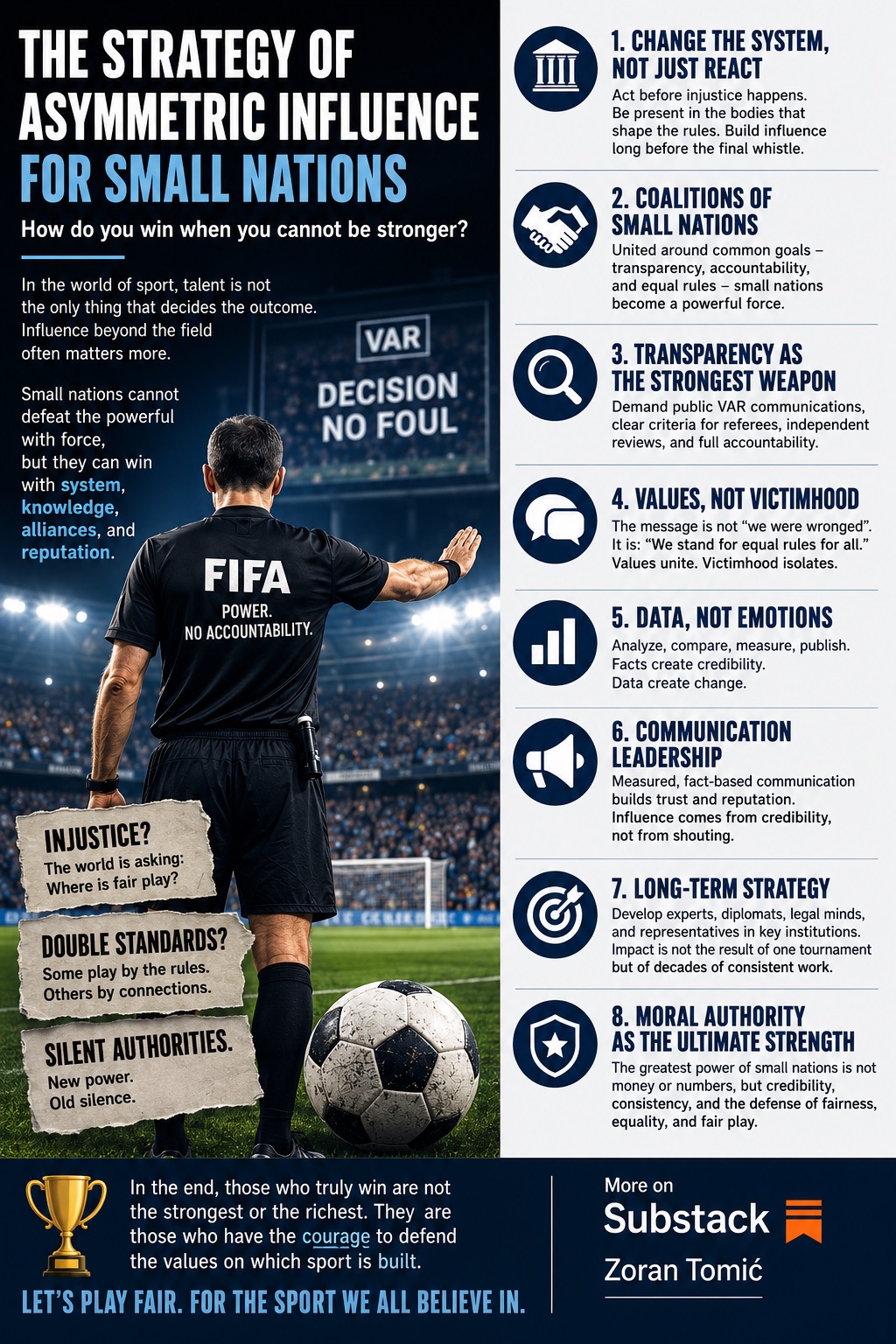
1. From Reaction to Systemic Influence
The greatest mistake small states make is that they begin to act only after they believe they have been treated unfairly.
By then, it is already too late.
Within contemporary international organisations, real power is not created after a match—it is created long before the tournament begins. Rules are developed within committees, commissions, working groups, and executive bodies. These are the arenas where procedures, standards, and decision-making criteria are established.
For this reason, small states must invest strategically in developing sports diplomats, international legal experts, elite referees, and governance specialists who can participate directly in institutional decision-making. The objective is not to win a single debate but to be present where the rules themselves are created.
The goal is not to change decisions after a championship.
The goal is to shape the system before the championship begins.
2. Coalitions of Small States: The Power of Collective Action
A single small state rarely possesses sufficient influence to reshape an international system.
Ten small states acting together represent a significant institutional and political force.
Football today is no longer merely a sport; it is also a domain of international governance and global politics. Just as states establish economic and security alliances, they should also develop alliances dedicated to safeguarding the integrity of sport.
Such a coalition would not be directed against any national team or governing institution. Rather, its purpose would be to advocate collectively for greater transparency, clearer regulations, more consistent standards, and stronger institutional accountability.
Collective voices invariably carry greater weight than isolated ones.
3. Transparency as the Most Powerful Instrument
In contemporary society, transparency has become a form of power.
Small states should avoid waging campaigns against individual referees or making accusations unsupported by evidence. Instead, they should consistently advocate for:
- the public release of VAR communications;
- transparent criteria for referee appointments;
- independent analyses of controversial decisions;
- regular reports assessing refereeing performance;
- greater institutional accountability toward the public.
Transparency is not an attack on institutions.
Transparency is the strongest protection institutions can possess.
Institutions trusted by the public are invariably stronger than institutions that remain silent.
4. Replace the Narrative of Victimhood with a Narrative of Values
Following controversial decisions, small states frequently respond emotionally.
While such reactions may generate immediate attention, they rarely produce long-term institutional change.
A far more effective strategy is to position themselves as defenders of the universal values upon which sport is founded.
The message should not be:
“We have been treated unfairly.”
Rather, it should be:
“We seek equal rules for everyone.”
This is not a national claim.
It is a universal principle.
Moreover, it is precisely this universality that grants it international legitimacy.
5. Data Rather Than Emotion
The greatest strategic resource of the twenty-first century is not rhetoric.
It is evidence.
Every disputed decision should be subjected to rigorous professional analysis, compared with previous cases, statistically evaluated, and publicly documented. Only then does the discussion move beyond emotion into the realm of evidence-based policy.
If empirical analysis demonstrates the absence of systematic bias, it will strengthen public confidence.
If it reveals consistent patterns requiring explanation, it will provide a legitimate foundation for institutional reform.
Impressions do not transform serious institutions.
They are transformed by evidence.
6. Communicative Leadership Instead of Noise
Small states must learn the distinction between visibility and influence.
International authority is earned not through louder voices but through greater credibility.
Communication should remain measured, evidence-based, and consistently focused on protecting the integrity of competition. Such an approach prevents a nation from appearing as a dissatisfied loser and instead presents it as a responsible guardian of the values that underpin sport.
Over time, these are precisely the voices that acquire genuine moral authority.
7. Long-Term Strategy Instead of Short-Term Frustration
Large institutions think in decades.
Too often, small states think from one match to the next.
A sustainable strategy, therefore, requires long-term investment in developing international referees, sports diplomats, sports law experts, communication specialists, and representatives capable of serving in all relevant international institutions.
Influence is never the product of a single tournament.
It is the outcome of decades of systematic engagement.
8. Moral Authority as the Greatest Strength of Small States
History repeatedly demonstrates that small states rarely prevail through numerical superiority or financial resources.
Their greatest comparative advantage has always been moral authority.
By consistently defending fairness, equality, transparency, and fair play, small states can gradually become the conscience of the international sporting community. Such a position cannot be purchased with financial capital or imposed through political power.
It must be earned through credibility.
Conclusion: The Struggle for the Meaning of Sport
At a time when sport has evolved into a global industry worth billions of euros, the most valuable asset is no longer stadium infrastructure, broadcasting rights, or commercial sponsorship.
The most valuable asset is trust.
If the public begins to believe that the rules are not applied equally to everyone, then it is not merely a single match or tournament that is called into question.
The very meaning of sport is placed at risk.
For this reason, small states should not define their mission as opposing larger nations or confronting international organisations. Their ambition should be far greater: to become guardians of the game’s integrity.
Ultimately, the greatest victories are not achieved by those who possess the greatest power.
They belong to those who possess the courage to defend the values upon which sport itself has been built.