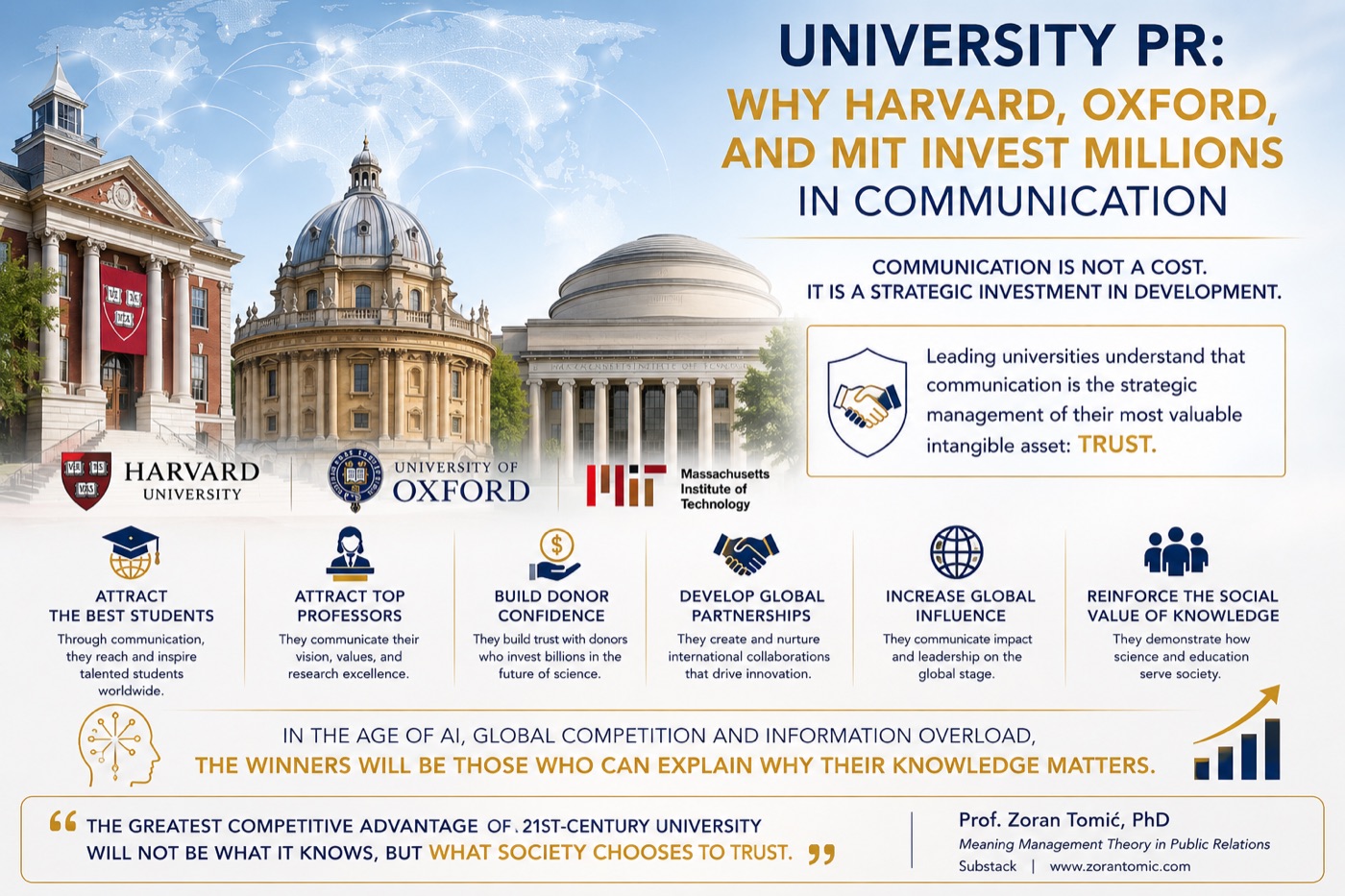
Communication is not a cost. It is a strategic investment in development.
One of the greatest misconceptions in higher education is the belief that excellence naturally speaks for itself.
It does not.
History shows that the world’s leading universities have never assumed that outstanding work would automatically reach the public. Harvard, Oxford, MIT, Stanford, and ETH Zurich have invested heavily in strategic communication for decades—not because they lack scientific achievements, but precisely because they understand their value.
This is not marketing.
This is not a promotion.
This is not about “polishing” reality.
It is the strategic management of the most valuable intangible asset a university possesses: trust.
The world’s leading universities have long understood that they do not compete globally solely through research and teaching. They also compete by explaining to different publics why their research matters, why their faculty members are changing the world, and why students should choose to build their future there.
Communication is therefore not the final stage of their work.
It is an integral part of their development strategy.
Through strategic communication, they attract the world’s most talented students.
They recruit outstanding professors and researchers.
They build the confidence of donors who invest billions of dollars in scientific advancement.
They establish international partnerships.
They strengthen their global influence.
They reinforce the social value of academic knowledge.
In other words, communication creates development opportunities.
This is the fundamental difference between an average university and a world-class university.
Average universities tend to view communication as an expense that needs to be justified.
Leading universities see communication as an investment that generates new value.
That is why their communication offices are no longer administrative units responsible for writing press releases.
They play a strategic role in international positioning, science communication, partnership development, reputation management, digital strategy, alumni and donor relations, and engagement with global university rankings.
This is no longer traditional Public Relations.
It is the strategic management of academic value.
In the age of artificial intelligence, global competition, and information overload, the winners will not be those who produce the greatest quantity of information.
The winners will be those who can explain why their knowledge matters.
That is why I believe the future of University Public Relations will be determined by one simple fact:
Universities will no longer compete only on the quality of their research. They will compete on their ability to make that research understandable, credible, and socially relevant.
And this is precisely where the new role of Public Relations begins.
Not as a promotional service.
But as the strategic infrastructure of university development.
The greatest competitive advantage of a 21st-century university will not be what it knows, but what society chooses to trust.