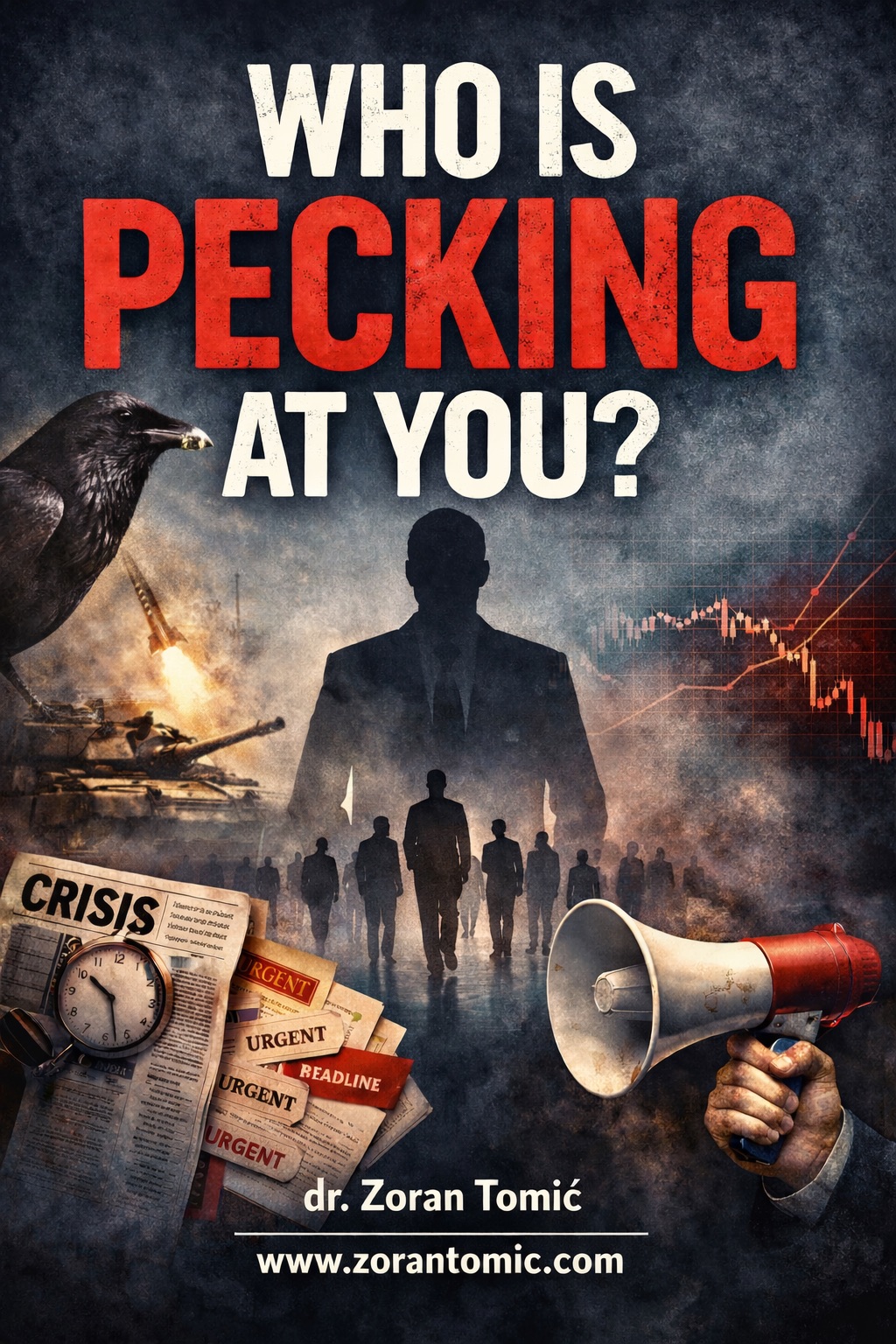
Every day, someone is pecking at us. Not necessarily openly, not always brutally, but persistently and systematically. We are pressured by deadlines, bills, regulations, crises, and news that instills fear and a sense of powerlessness. We are pecked at by political decisions we did not make, by markets we do not control, and by systems in which we are always one step below those who decide. While we ask ourselves why we are constantly tired, tense, and insecure, we rarely ask who stands above us in this invisible pecking order. Who has the right to apply pressure, and who must retreat? That very question – who is pecking at you? – opens the space for understanding the world we live in, a world that still behaves like a hierarchical chicken coop beneath the polished language of politics and economics.
I. The Pecking Order in International Relations
The term pecking order originates in zoology and describes the hierarchical structure within animal groups, particularly among birds. In such a system, each individual knows its place: it may peck those below it but must yield to those stronger. Although it may appear to be a simple biological phenomenon, the pecking order has proven to be a beneficial concept for understanding human societies – including global politics.
According to Merriam-Webster, a pecking order is a social hierarchy or dominance hierarchy within a group. Such an order does not arise by chance. It is established through conflict, competition, and demonstrations of power. Once stabilized, however, open conflict becomes less frequent. The rules are straightforward: dominant actors gain access to resources, security, and decision-making power, while subordinate actors adapt to avoid punishment.
The same logic is evident in international relations. Global politics functions as a hierarchical system in which states are far from equal. Some possess the power to impose rules, while others can only react. In this global “chicken coop,” the top of the pecking order is occupied by major powers such as the United States, China, and Russia, as well as alliances like the European Union. Their economic, military, and political strength allows them to “peck”: to impose sanctions, define international norms, decide on war and peace, and shape dominant narratives.
Below them are states that can occasionally bare their teeth but remain exposed to pressure from stronger actors. They balance between the interests of major powers, fully aware that open resistance may come at a high cost. At the bottom of the hierarchy are countries that depend almost entirely on decisions made by others – economically, politically, or in terms of security. Their role in global politics is often reduced to adaptation and survival.
Critical Reflection
The question “who is pecking at you?” is therefore not merely rhetorical, but deeply personal as well as political. It reveals that international relations, despite the rhetoric of equality and law, continue to rest on power. Morality, democracy, and international law are frequently applied selectively – as tools wielded by those strong enough to enforce or ignore them.
As in the animal world, hierarchy is presented as natural and inevitable. However, it is precisely in this “naturalness” that the greatest danger lies: the acceptance of injustice as usual. Understanding the global pecking order is the first step toward critically reflecting on one’s own position in the world. As long as we do not know who is pecking, it is difficult to decide whether to keep bowing our heads forever or to attempt to change the order.
II. Crows – Masters of Intelligence and Social Hierarchy
Crows are fascinating creatures, known for their exceptional intelligence and complex social structures. Their hierarchy, also known as a pecking order, is not based solely on physical strength, but on wisdom, social bonds, and adaptability. Dominant individuals lead the flock, securing the best access to food and nesting sites, while mid-ranked crows constantly seek to improve their status through social interaction. Younger and weaker birds occupy lower positions, but often form alliances to increase their chances of survival.
What makes the crow hierarchy distinctive is how it is formed. Instead of open aggression, crows rely on cunning and strategy, using tests of newcomers, observational learning, and sophisticated communication. Vocalizations, eye contact, and subtle gestures help maintain order within the group and prevent unnecessary conflict. This structure ensures stability within the flock, reduces internal clashes, and provides better defense against predators.
Crow Tricks
Their intelligence is evident not only in social organization but also in the remarkable tricks they employ in everyday life. Crows recognize human faces and remember them for years, distinguishing friends from enemies. If threatened, they not only remember the individual but also warn other crows of the potential danger. They are also known for using tools – twigs, stones, and even bent wires – to obtain food, and laboratory experiments have shown their ability to modify tools to solve problems.
Their social strategies include forming alliances, sharing food information only with trusted members, and subtle deception, such as hiding food in false locations to prevent theft. Communication among crows is more complex than it appears: different calls convey information about predators, food availability, and changes within the hierarchy. When collective decisions are required, crows rely on group “voting,” demonstrating a high level of social organization.
All of these traits make crows among the most intelligent creatures on the planet. Their ability to recognize faces, use tools, adapt to social dynamics, and make collective decisions shows that they are masters of survival in the natural world. Their lives are not merely struggles for food and territory, but complex games of strategy, communication, and social intelligence.
III. Knowing Who Is Pecking Means Knowing Where You Stand
The world we live in is not as chaotic as it appears – it is hierarchical. The pecking order did not disappear with the chicken coop; it merely moved into politics, economics, media, and everyday life. The difference today is that the beaks are more invisible, more refined, and often wrapped in the language of necessity, crisis, and “there is no alternative.” This is why the question “who is pecking at you?” is not paranoid, but liberating. It exposes power relations, strips away the illusion of neutrality. It restores a basic political and personal orientation: awareness of where we stand in the order and who benefits from our constant retreat. As with crows, hierarchy exists – but it is not static. It persists only as long as it is accepted without question.
Personal Recommendations: How Not to Be Pecked Without Resistance
- Distinguish pressure from necessity.
- Not everything presented as “normal” or “inevitable” truly is. Crows survive because they observe, remember, and learn – they do not react impulsively. We should ask more often: who benefits from this decision, this news, this fear?
- Reduce exposure to constant panic squawking.
- Media and social networks often serve as the system’s extended beaks. Stay informed, but selectively. Constant exposure to crises does not increase your power – only your exhaustion.
- Build alliances, not illusions of self-sufficiency.
- Crows survive through cooperation. An individual in a hierarchical world is not weak because they are alone, but because they believe they must face everything alone. Solidarity, professional networks, and communities are ways of shifting one’s position within the order.
- Do not peck those below you to feel safer.
- The system survives because frustration is often redirected toward those beneath us. Refuse to participate in this chain. Recognizing your position does not mean finding a victim, but finding an exit.
- Cultivate strategic intelligence, not constant resistance.
- Crows do not attack without reason. They wait, observe, and act when it makes sense. Permanent rebellion exhausts; conscious positioning strengthens.
In the end, the goal is not to escape hierarchy – that is an illusion. The goal is to recognize the pecking order, reduce its power over you, and learn to move within it with greater awareness, less fear, and more dignity. Because the moment we know who is pecking at us, we stop being birds that merely retreat – and begin choosing when to remain silent and when to spread our wings.